
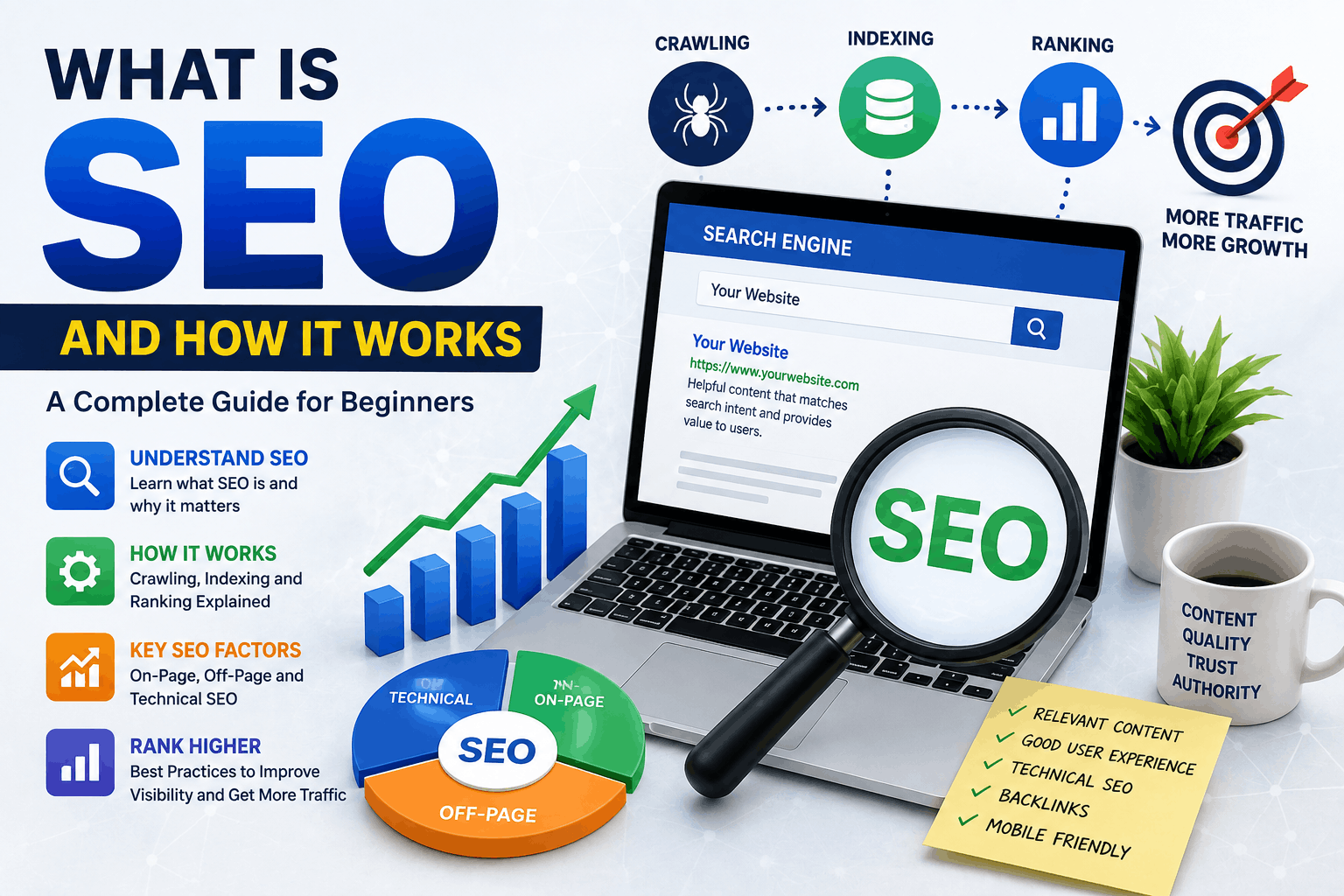
Search engines have become one of the most important ways people discover information, products, services, businesses, and solutions online. When someone searches for “best digital marketing course,” “home tutor near me,” “how to start a business,” or “best laptop for students,” search engines decide which pages should appear in the results.
This is where SEO, or Search Engine Optimization, becomes important.
SEO helps websites improve their visibility in search engines and attract people who are actively looking for information, products, or services related to what the website offers.
Unlike paid advertising, SEO does not require you to pay a search engine every time someone clicks your result. Instead, SEO focuses on making a website useful, accessible, technically sound, trustworthy, and relevant to what people are searching for.
But SEO is often misunderstood. It is not simply about inserting keywords into an article or trying to manipulate Google’s algorithm. Modern SEO involves content quality, search intent, website experience, technical performance, authority, and continuous improvement.
In this guide, we will explain what SEO is, how SEO works, why it matters, the major types of SEO, how search engines evaluate websites, and how beginners can start implementing SEO effectively.
What Is SEO?
SEO stands for Search Engine Optimization.
It is the practice of improving web pages and websites so that search engines can understand them and users can discover and use them more easily through organic search results.
The word organic is important.
Organic search results are the unpaid listings that appear because the search engine considers them relevant and useful for a particular query.
For example, suppose you search Google for:
“How to learn digital marketing.”
Google may display articles, videos, courses, websites, and other resources that its systems believe can best answer your question.
Businesses and website owners use SEO to improve their chances of appearing prominently for relevant searches.
SEO can help with:
- Increasing organic website traffic
- Improving online visibility
- Generating leads
- Attracting potential customers
- Building brand awareness
- Increasing sales
- Establishing authority
- Reaching people with specific search needs
However, SEO is not a guaranteed shortcut to the first position on Google.
Search rankings depend on many factors: competition, search intent, website quality, content relevance, technical factors, and the search engine’s systems.
How Does SEO Work?
To understand SEO, you first need to understand how search engines work.
Search engines generally perform three important activities:
- Crawling
- Indexing
- Ranking
Let’s understand each one.
1. Crawling
Search engines use automated systems, commonly called crawlers or bots, to discover webpages.
These crawlers follow links from one page to another and discover new or updated content.
For example:
Your website has a homepage.
The homepage links to your blog.
The blog links to an article.
That article links to another page.
Search engine crawlers can follow these connections and discover additional content.
A website’s technical structure can therefore affect how easily search engines discover its pages.
Important elements include:
- Internal links
- XML sitemaps
- Proper URLs
- Server accessibility
- Robots.txt configuration
- Website architecture
If a page cannot be accessed or discovered properly, it may have difficulty appearing in search results.
2. Indexing
After discovering a webpage, a search engine needs to understand and store information about it.
This process is called indexing.
Think of a search engine’s index as a huge organized library.
When a page is indexed, the search engine can understand information such as:
- What the page is about
- What topics it covers
- What words and concepts appear on it
- Whether the page is accessible
- How it relates to other pages
- Whether it contains useful information
Not every page discovered by a search engine necessarily appears in search results.
A page may be excluded from indexing for technical reasons, because it is inaccessible, because of explicit instructions, or for other reasons.
Therefore, publishing a webpage is only the beginning.
You need to make sure search engines can discover, understand, and potentially index it.
3. Ranking
When someone enters a search query, the search engine needs to determine which indexed pages are the most appropriate results.
This is the ranking process.
Search engines use sophisticated systems and numerous signals to determine which results to display.
These can relate to:
- Relevance
- Content quality
- Search intent
- Website experience
- Page usability
- Authority
- Links
- Location
- Language
- Freshness where appropriate
- Other contextual factors
The exact algorithms are complex and continuously evolving.
This is why nobody can honestly guarantee that a website will permanently rank at number one for a competitive keyword.
Good SEO focuses on building a website that deserves visibility rather than trying to discover a single secret ranking trick.
What Is a Search Query?
A search query is the phrase or question a person enters into a search engine.
Examples include:
- “best digital marketing course”
- “how to learn SEO”
- “maths tutor near me”
- “SEO agency in Mumbai”
- “how does Google ranking work”
Every search query represents a potential search intent.
Understanding that intent is one of the most important parts of SEO.
What Is Search Intent?
Search intent means the reason behind a search.
Someone searching for:
“What is SEO?”
is probably looking for educational information.
Someone searching for:
“best SEO course online”
may be comparing learning options.
Someone searching for:
“buy SEO course”
has a stronger commercial or transactional intention.
If your content does not match the reason behind the search, it may struggle to perform well even if it contains the right keywords.
This is why modern SEO is not simply about keywords.
It is about understanding what the searcher wants and creating the best useful response.
What Is Keyword Research?
Keyword research is the process of identifying the words and phrases people use when searching for information, products, or services.
For example, a tutoring business might discover keywords such as:
- Online maths tutor
- Class 10 maths tutor
- CBSE maths tutor
- Maths tutor near me
- Home tuition for class 10
Keyword research can help you understand:
- What people search for
- How frequently they search
- How competitive a topic may be
- What related topics exist
- What type of content users may expect
However, keyword research should not become an exercise in stuffing keywords into pages.
A page should naturally address the topic.
What Is On-Page SEO?
On-page SEO refers to improvements made directly to webpages and their content.
Important elements include:
SEO Title
The title helps users and search engines understand the main subject of the page.
Headings
Headings organize content and make long articles easier to understand.
Content
Useful, original, relevant content is at the heart of SEO.
URLs
Clear and descriptive URLs can make page topics easier to understand.
Internal Links
Internal links connect related pages on your website and help users navigate your content.
Images
Images can improve comprehension and engagement when they are relevant and properly optimized.
Meta Description
A meta description can provide a short summary of a page in search results. Although it is not simply a direct ranking lever, a useful description can help users understand what the page offers.
What Is Technical SEO?
Technical SEO focuses on the technical foundation of a website.
It helps search engines access, understand, and process your website efficiently.
Important areas include:
- Website speed
- Mobile usability
- HTTPS
- Crawlability
- Indexability
- XML sitemaps
- Robots.txt
- Canonical URLs
- Structured data
- Website architecture
- Broken links
- Redirects
- Core Web Vitals
You don’t need to be a professional programmer to understand the basics of technical SEO.
However, websites with significant technical problems may struggle to perform effectively in organic search.
What Is Off-Page SEO?
Off-page SEO refers to activities that happen outside your own website that can contribute to its reputation, visibility, or authority.
One of the most well-known areas is link building.
A backlink is a link from another website to your website.
For example, if a respected education website references your article and links to it, that can provide a useful discovery and authority signal.
But not all links are equally valuable.
The goal should not be to collect thousands of random backlinks.
Instead, focus on earning relevant, trustworthy references through:
- High-quality content
- Digital PR
- Original research
- Industry resources
- Useful guides
- Partnerships
- Genuine mentions
SEO should never become a race to acquire as many links as possible.
What Is Local SEO?
Local SEO helps businesses become more visible when people search for services in a particular geographic area.
Examples include:
- Dentist near me
- Restaurant near me
- Digital marketing agency in Mumbai
- Maths tutor in Pune
- Coaching centre near me
Local SEO can involve:
- Google Business Profile
- Local business information
- Reviews
- Business directories
- Location-specific website pages
- Local content
- Consistent business information
For businesses that serve specific cities or regions, local SEO can be extremely valuable.
What Is Content SEO?
Content is one of the central components of SEO.
A strong SEO content strategy focuses on answering real questions and satisfying real information needs.
Useful SEO content might include:
- Guides
- Tutorials
- Comparisons
- FAQs
- Case studies
- Original research
- Product information
- Educational articles
- Videos
- Images
- Interactive resources
Instead of writing an article simply because a keyword has high search volume, ask:
What would make this page genuinely useful to someone searching for this topic?
That question leads to better content.
Why Are Internal Links Important?
Imagine a website with hundreds of pages, but none of those pages are connected.
Users may struggle to discover related information.
Internal links create pathways between pages.
For example:
An article about SEO basics could link to:
- Keyword research
- Technical SEO
- Local SEO
- Content marketing
- SEO analytics
This helps users explore related information and helps search engines understand relationships between pages.
A well-planned internal linking structure can therefore strengthen both usability and website architecture.
Why Does Website Speed Matter?
People generally prefer websites that load quickly and respond smoothly.
A slow website can create frustration and may lead users to leave before engaging with the content.
Website performance can be affected by:
- Large images
- Excessive scripts
- Poor hosting
- Unnecessary plugins
- Unoptimized code
- Third-party resources
Improving performance can therefore benefit both user experience and overall website quality.
Is Mobile SEO Important?
Absolutely.
A large amount of web traffic comes from mobile devices.
A website should therefore work properly across different screen sizes.
Check whether:
- Text is readable
- Buttons are easy to tap
- Images fit the screen
- Menus work properly
- Forms are usable
- Pages load efficiently
A website that looks excellent on desktop but is difficult to use on a smartphone can provide a poor experience.
How Does Google Decide Which Page Ranks First?
There is no single “SEO score” that guarantees the first position.
Google uses complex systems to evaluate and organize search results.
A page may perform well when it provides a strong combination of:
- Relevance to the query
- Helpful information
- Good user experience
- Clear content structure
- Appropriate technical accessibility
- Credible information
- Useful references and connections
- Strong topical coverage
Competition also matters.
If ten websites provide excellent information about a topic, ranking can be difficult.
For highly competitive keywords, SEO may require months or longer of consistent effort.
How Long Does SEO Take?
SEO usually takes time.
Unlike paid advertising, where you can potentially generate traffic shortly after launching a campaign, organic SEO growth is generally gradual.
The timeline depends on factors such as:
- Website age
- Existing authority
- Competition
- Content quality
- Technical condition
- Industry
- Search demand
- Backlink profile
- Consistency
- Search intent
A new website may need considerable time to establish visibility.
This is why SEO should be treated as a long-term marketing investment rather than a quick trick.
Common SEO Mistakes Beginners Make
Keyword Stuffing
Repeating a keyword unnaturally can make content difficult to read.
Write naturally and cover the topic comprehensively.
Copying Other Websites
Duplicate or heavily copied content provides little unique value.
Create your own perspective, examples, research, and explanations.
Buying Low-Quality Backlinks
Large quantities of irrelevant or manipulative links can create problems rather than solving them.
Ignoring Technical SEO
Excellent content cannot perform at its full potential if search engines cannot access the website properly.
Writing Only for Search Engines
Your audience should always come first.
Publishing and Forgetting
SEO requires monitoring and improvement.
Look at performance and update pages when necessary.
Chasing Every New SEO Trick
Search engine optimization changes over time.
Focus on fundamentals instead of constantly chasing rumors about algorithm updates.
How to Start SEO as a Beginner
If you are new to SEO, follow a simple process.
Step 1: Learn SEO fundamentals
Understand crawling, indexing, ranking, keywords, search intent, and content quality.
Step 2: Create a website or blog
The best way to learn SEO is through practical experience.
Step 3: Research your audience
Find out what questions your audience is asking.
Step 4: Perform keyword research
Identify relevant topics and search phrases.
Step 5: Create useful content
Write original, detailed, reader-focused articles.
Step 6: Optimize your pages
Improve titles, headings, URLs, internal links, images, and content structure.
Step 7: Fix technical problems
Improve performance, mobile usability, crawlability, and indexing.
Earn mentions and links by publishing valuable resources.
Step 9: Monitor results
Use tools such as Google Search Console and analytics platforms to understand performance.
Step 10: Improve continuously
Update content, test improvements, and learn from your data.
SEO vs Paid Advertising
SEO and paid advertising are different but complementary strategies.
With paid advertising, businesses pay platforms to display advertisements.
With SEO, businesses aim to earn organic visibility.
SEO Advantages
- Can generate long-term traffic
- Builds organic visibility
- Can strengthen brand authority
- Traffic doesn’t require paying for every individual click
Paid Advertising Advantages
- Can generate visibility quickly
- Precise campaign targeting
- Easier to scale campaigns immediately
- Useful for testing offers and audiences
Many successful businesses use both.
SEO can build sustainable organic traffic while paid advertising provides immediate campaign reach.
The Future of SEO
SEO continues to evolve.
Search is no longer limited to ten blue links.
People increasingly discover information through:
- Traditional search
- Videos
- Maps
- Social platforms
- AI-powered search experiences
- Voice interfaces
- Shopping results
- Specialized search tools
This means businesses need to think beyond individual keywords.
The future of SEO is increasingly about being discoverable wherever potential customers search for information.
High-quality content, strong brand identity, useful experiences, trustworthy information, and technical accessibility will continue to matter.
AI is also changing how people search and how marketers create and optimize content. This makes it even more important to focus on genuine expertise, originality, accuracy, and usefulness.
Final Thoughts
SEO is much more than placing keywords inside an article.
It is a long-term process of making your website easier to discover, understand, use, and trust.
The fundamental SEO journey can be summarized as:
Understand your audience → Research search intent → Create useful content → Optimize your website → Improve technical performance → Build authority → Measure results → Keep improving.
If you are learning SEO for the first time, don’t try to master everything in one day.
Start with one website.
Choose one topic.
Create one useful page.
Optimize it properly.
Measure what happens.
Then create another.
With consistent practice, you will begin to understand how search engines, users, content, technical SEO, and marketing strategy work together.
The most successful SEO strategy is rarely about finding a secret trick.
It is about consistently creating something that deserves to be found.
SEO works best when you stop thinking only about ranking a page and start thinking about helping the person who searched for it.
1 thought on “What Is SEO and How Does It Work? A Complete Beginner’s Guide”