
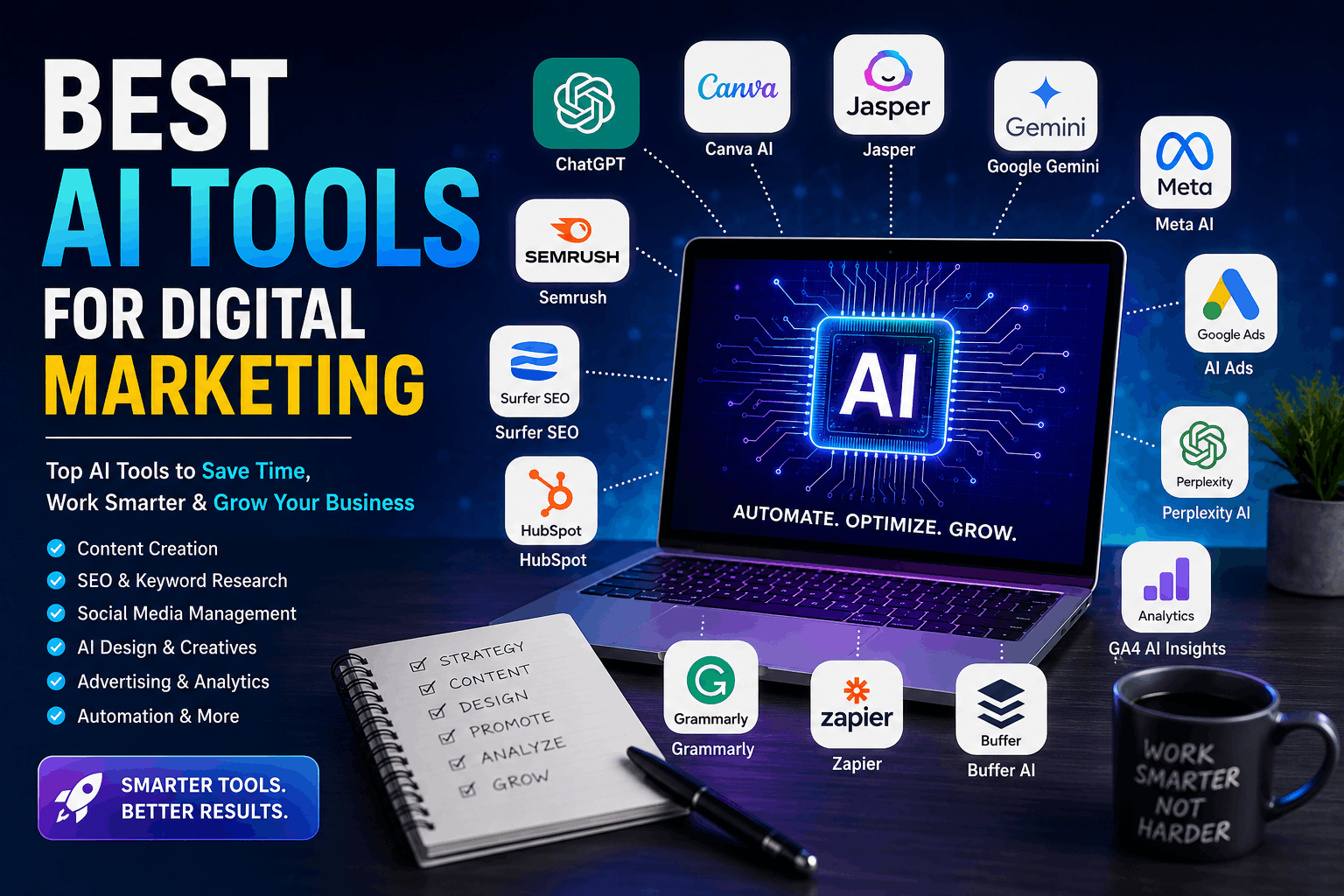
Artificial intelligence has changed the way digital marketing is planned, created, executed, and measured. Tasks that once required hours of research, writing, design, analysis, and campaign management can now be accelerated with AI-powered software.
But there is one important point to understand: AI tools do not automatically make someone a great digital marketer. The real advantage comes from knowing which tool to use, what to ask it to do, how to evaluate its output, and how to connect it with an effective marketing strategy.
In 2026, AI is increasingly built directly into the platforms marketers already use. Google, Canva, HubSpot, advertising platforms, SEO platforms, analytics systems, and content tools are all incorporating AI into their workflows.
This guide explores the best AI tools for digital marketing in 2026, organized by practical marketing requirements such as content creation, SEO, graphic design, social media, advertising, research, email marketing, automation, and analytics.
What Are AI Tools for Digital Marketing?
AI marketing tools are software applications that use technologies such as generative AI, machine learning, natural language processing, predictive analytics, and automation to help marketers complete tasks more efficiently.
Depending on the platform, AI can help with:
- Content creation
- Keyword research
- SEO analysis
- Competitor research
- Social media content
- Graphic design
- Video creation
- Ad copy
- Audience segmentation
- Email marketing
- Lead scoring
- Customer support
- Data analysis
- Marketing automation
- Personalization
The important difference between traditional software and modern AI tools is that AI can often interpret instructions expressed in natural language and produce recommendations or content based on the information provided.
For example, instead of manually creating ten variations of an advertisement, a marketer can ask an AI tool to develop different headlines, descriptions, calls to action, and creative concepts for different audiences.
Canva describes AI marketing tools as solutions designed to support, automate, and improve marketing activities, while emphasizing that they are intended to support human marketers rather than simply replace them.
1. ChatGPT – Best All-Round AI Marketing Assistant
ChatGPT is one of the most versatile AI tools available to digital marketers.
It can be used throughout the marketing workflow, from the initial idea to campaign planning and content development.
What can marketers use ChatGPT for?
You can use it to:
- Generate blog ideas
- Create content outlines
- Draft social media posts
- Write advertising variations
- Develop email sequences
- Brainstorm campaign concepts
- Create video scripts
- Build customer personas
- Analyse marketing data
- Develop content calendars
- Create FAQs
- Generate landing-page copy
- Rewrite content for different audiences
The biggest advantage is flexibility.
For example, a marketer can provide information about a business, target audience, product, tone of voice, and marketing objective and ask for several campaign concepts.
ChatGPT should not simply be treated as a “blog writer.” It can function as a brainstorming partner, research assistant, campaign planner, copywriting assistant, and analysis assistant.
However, marketers should always review AI-generated information before publishing it.
Current marketing guides continue to identify ChatGPT as a major general-purpose tool for content, research, planning, and campaign execution.
Best for:
Content planning, copywriting, brainstorming, research, strategy and productivity.
2. Google Gemini – Useful for Research and Google Ecosystem Workflows
Google Gemini is another important AI platform for marketers.
Its usefulness is particularly interesting for marketers who already work extensively with Google’s ecosystem.
Digital marketers can use AI assistants such as Gemini for:
- Brainstorming
- Research
- Content ideas
- Summarization
- Marketing planning
- Data interpretation
- Creative concepts
- Campaign research
Google is also integrating Gemini into its advertising and marketing ecosystem.
At Google Marketing Live 2026, Google announced additional AI-powered marketing capabilities, including Business Agent for Leads, AI Brief, Asset Studio improvements, Ask Advisor, and other AI-driven advertising and measurement features.
This demonstrates an important trend: AI is moving from being a separate application to becoming part of the marketing platforms themselves.
Best for:
Research, brainstorming, Google ecosystem workflows and AI-assisted marketing.
3. Canva AI – Best for Marketing Design
Digital marketing is highly visual.
A social media campaign may require:
- Instagram posts
- Reels covers
- Facebook creatives
- YouTube thumbnails
- Presentation slides
- Posters
- Infographics
- Advertisements
- Website graphics
Canva has become particularly useful because it combines design templates with AI-powered creative features.
Canva’s AI marketing resources highlight applications including content generation, research assistance, creative production, and AI-powered design workflows.
For marketers who are not professional graphic designers, this can significantly reduce the time required to produce marketing assets.
The best approach is not to let AI decide everything. Give it your brand colours, typography, audience, message, campaign objective, and visual direction.
Best for:
Social media graphics, presentations, posters, advertisements and visual marketing content.
4. Jasper – Best for Marketing-Focused Content
Jasper is designed specifically around marketing content workflows.
It can be useful for organizations that produce large volumes of marketing content and want consistency across campaigns.
Potential applications include:
- Blog content
- Advertising copy
- Email campaigns
- Social media content
- Marketing briefs
- Brand messaging
- Campaign variations
One advantage of specialized marketing platforms is that they can provide workflows designed around specific marketing requirements rather than general conversation.
Jasper is frequently included among leading AI content tools for marketing teams.
Best for:
Marketing teams producing content at scale.
5. Semrush – Best AI-Powered SEO and Competitive Research
SEO is one of the areas where AI can save marketers substantial research time.
Semrush is a major SEO and digital marketing platform with capabilities covering areas such as keyword research, competitive analysis, content strategy, and search performance.
AI-assisted SEO workflows can help marketers identify:
- Search opportunities
- Keyword themes
- Content gaps
- Competitor strategies
- Search intent
- Content ideas
- Optimization opportunities
The important point is that SEO tools should not replace SEO knowledge.
A marketer still needs to understand search intent, content quality, topical relevance, technical SEO, backlinks, user experience, and conversion optimization.
Modern AI SEO guides commonly list Semrush among the leading tools for keyword research, competitor analysis, content gaps, and AI-assisted content workflows.
Best for:
SEO research, competitor analysis and content strategy.
6. Surfer SEO – Best for Content Optimization
Creating an article is only the beginning of SEO.
You also need to understand whether the content adequately addresses the topic and search intent.
Surfer SEO is designed to help marketers optimize content using search-related data.
It can assist with:
- Content optimization
- Topic coverage
- Keyword usage
- Content structure
- Competitor comparison
- SEO content planning
For bloggers and SEO professionals, tools like Surfer can make the optimization process more systematic.
However, marketers should avoid blindly adding keywords simply because a tool recommends them.
A useful article should primarily satisfy the reader.
Best for:
SEO content optimization and on-page content improvement.
7. HubSpot AI – Best for CRM and Marketing Automation
HubSpot is particularly valuable for businesses that want to connect marketing, sales, customer relationship management, and automation.
AI-powered CRM workflows can help businesses with:
- Lead management
- Customer segmentation
- Email campaigns
- Lead scoring
- Marketing automation
- Customer communication
- Sales follow-up
- Reporting
This becomes increasingly important as a company grows.
Imagine a business receiving hundreds of enquiries every month. Simply generating more leads isn’t enough. The business also needs to organize, prioritize, nurture, and follow up with those leads.
AI can assist with these processes.
HubSpot’s AI marketing ecosystem is frequently positioned as an all-in-one solution for CRM-connected marketing workflows.
Best for:
CRM, lead management, marketing automation and customer journeys.
8. Perplexity – Useful for Research and Information Discovery
Digital marketers constantly need information.
They research:
- Competitors
- Industries
- Customers
- Market trends
- Products
- Topics
- Content ideas
- Questions customers ask
AI-powered research tools can make the initial research process faster.
Perplexity is particularly useful when you want an AI interface that helps explore questions and information sources.
However, marketers should still verify important facts and use reliable primary sources when making claims in professional content.
Best for:
Research, topic exploration and information discovery.
9. Grammarly – AI-Assisted Writing and Editing
Even when a marketer has excellent ideas, poor grammar or unclear writing can reduce credibility.
AI writing assistants can help identify:
- Grammar errors
- Spelling mistakes
- Awkward sentences
- Tone problems
- Clarity issues
- Unnecessary wording
This is particularly useful for:
- Emails
- Website copy
- Social media
- Advertisements
- Blog posts
- Proposals
- Professional communication
AI should help improve your writing—not remove your personality from it.
Best for:
Proofreading, clarity, grammar and communication.
10. AI Tools Built into Google Ads
Paid advertising is one of the areas where AI has become deeply integrated into marketing platforms.
Google’s advertising ecosystem uses AI for functions such as campaign optimization, targeting, bidding, creative assistance, and performance recommendations.
Google’s 2026 marketing announcements show how AI is increasingly being used across Search, YouTube, Shopping, creative production, and measurement.
Google Performance Max is one example of an AI-driven campaign approach that can optimize activity across Google’s advertising inventory.
For marketers, the lesson is important:
You don’t always need a separate AI application. Sometimes the best AI tool is already inside the platform you are using.
Best for:
Paid advertising, campaign optimization and automated performance management.
11. Meta AI and Advantage+ – Best for Facebook and Instagram Advertising
Meta has also integrated AI into its advertising ecosystem.
AI can assist with:
- Audience targeting
- Campaign optimization
- Creative testing
- Budget allocation
- Ad delivery
For businesses that depend heavily on Facebook and Instagram, these built-in AI capabilities can become an important part of their advertising strategy.
However, the marketer still needs to provide the right inputs:
- Strong creative
- Clear offer
- Correct audience strategy
- Good landing page
- Appropriate campaign objective
- Accurate conversion tracking
AI can optimize a campaign, but it cannot fix a fundamentally weak offer.
Best for:
Facebook and Instagram advertising optimization.
Social media marketers often struggle with consistency.
You need to continuously:
- Find ideas
- Write captions
- Create visuals
- Schedule posts
- Monitor engagement
- Analyze performance
AI-powered social media tools can help simplify this workflow.
They can assist with content ideas, caption generation, scheduling, and performance analysis.
The marketer should still maintain a clear brand voice and avoid publishing generic AI-generated content that looks identical to thousands of other accounts.
Best for:
Social media planning, content creation and scheduling.
13. AI Video Tools for Digital Marketing
Video has become one of the most important formats in digital marketing.
Businesses increasingly use:
- Short videos
- Reels
- YouTube videos
- Product demonstrations
- Educational videos
- Advertisements
- Explainer videos
AI video tools can assist with:
- Script creation
- Storyboarding
- Voiceovers
- Subtitles
- Video editing
- Visual generation
- Repurposing long videos into short clips
This means one long-form video can potentially become multiple pieces of marketing content.
For example:
One webinar → one YouTube video → five short videos → ten social posts → one blog article → several email ideas.
That is the power of combining AI with a content repurposing strategy.
14. Google Analytics 4 – AI-Assisted Marketing Measurement
Creating content and campaigns is only half of digital marketing.
The other half is measurement.
Google Analytics 4 can help marketers understand website activity and user behavior.
You can examine:
- Traffic
- User engagement
- Acquisition channels
- Conversions
- Landing-page performance
- User journeys
- Campaign results
AI-powered insights can make large amounts of marketing data easier to interpret.
A good marketer should not simply report that traffic increased.
The marketer should ask:
Where did the traffic come from?
Did visitors engage?
Did they generate leads?
Did they purchase?
Which campaign generated the highest-quality customers?
This difference separates data reporting from real marketing analysis.
15. Zapier – Best for Connecting Marketing Tools
One of the biggest opportunities with AI is automation.
Imagine this workflow:
A customer fills out a form → the lead enters your CRM → an email is sent → the sales team receives an alert → the lead is categorized → follow-up is scheduled.
Automation platforms such as Zapier can connect different applications and reduce repetitive manual work.
AI can make these workflows even more intelligent by helping classify information, summarize conversations, or trigger actions based on specific conditions.
Best for:
Marketing automation and connecting multiple applications.
How to Choose the Right AI Marketing Tools
You don’t need 20 AI subscriptions.
In fact, using too many tools can create more complexity.
Start by identifying your biggest marketing problem.
If your problem is content:
Start with ChatGPT + Canva.
If your problem is SEO:
Consider Semrush + Surfer SEO + Google Search Console.
If your problem is advertising:
Focus on Google Ads AI features + Meta Advantage+.
If your problem is CRM:
Consider HubSpot.
If your problem is analytics:
Focus on Google Analytics 4 + Looker Studio.
If your problem is automation:
Consider Zapier.
The best AI marketing stack is not necessarily the biggest one. It is the one that solves your biggest bottleneck.
Free vs Paid AI Marketing Tools
Beginners often believe they need expensive software to start digital marketing.
That’s not true.
You can start learning with free or limited-access versions of several tools.
For example, beginners can experiment with:
- ChatGPT
- Canva
- Google Analytics
- Google Search Console
- Google Ads tools
- Meta advertising tools
Some advanced SEO and marketing platforms become more valuable as your business grows.
A sensible approach is:
Start free → learn the workflow → measure the benefit → upgrade when necessary.
Don’t purchase an expensive subscription simply because a tool is popular.
How to Use AI Without Losing Your Marketing Skills
This is one of the most important lessons for beginners.
AI should make you better, not dependent.
Don’t ask:
“Write everything for me.”
Instead, ask:
“Help me understand my audience.”
Then:
“Give me five campaign strategies.”
Then:
“Compare the advantages and disadvantages.”
Then:
“Create a draft based on the strategy I selected.”
Finally:
“Help me improve the draft.”
This approach keeps the human marketer in control.
AI can generate options, but you make the strategic decisions.
Canva and other industry resources similarly emphasize AI as a tool that supports human marketers and helps them spend more time on decision-making.
The Future of AI in Digital Marketing
The next phase of digital marketing is likely to move beyond simple content generation.
AI systems are increasingly becoming capable of handling multi-step workflows.
Instead of simply asking an AI to write an advertisement, marketers may increasingly use AI systems that can:
- Research the audience.
- Analyse competitors.
- Develop campaign concepts.
- Create creative variations.
- Launch or assist with campaigns.
- Monitor performance.
- Identify problems.
- Recommend changes.
- Produce reports.
Google’s 2026 marketing announcements already show this direction, with features such as Ask Advisor and AI-powered campaign and creative capabilities designed to provide more proactive assistance.
The role of the marketer will therefore evolve.
Instead of spending most of the day performing repetitive tasks, marketers can spend more time on:
- Strategy
- Positioning
- Creativity
- Customer psychology
- Brand building
- Offer development
- Data interpretation
- Business decisions
Common Mistakes When Using AI for Marketing
1. Publishing AI Content Without Editing
AI-generated content can contain inaccuracies, repetitive language, or generic ideas.
Always review it.
2. Using the Same Prompt for Everything
Better prompts usually produce better results because they provide context, audience, objective, tone, and constraints.
3. Ignoring Brand Voice
Your marketing should sound like your business—not like a generic AI assistant.
4. Focusing Only on Speed
Creating ten pieces of poor content faster isn’t necessarily better marketing.
Quality still matters.
5. Ignoring Customer Data and Privacy
Marketers must be careful about what confidential or sensitive information they provide to AI systems.
6. Believing AI Can Replace Strategy
AI can provide suggestions, but humans remain responsible for important marketing decisions.
A Practical AI Digital Marketing Stack for Beginners
If you are just starting, you don’t need a complicated setup.
A simple beginner stack could be:
ChatGPT – content and marketing ideas
Canva – visual content
Google Search Console – SEO monitoring
Google Analytics 4 – website analytics
Google Ads – paid search and AI-powered advertising features
Meta Ads – Facebook and Instagram advertising
Buffer or another scheduler – social media management
As your business grows, you can add specialized SEO, CRM, automation, email, analytics, and advertising tools.
Final Thoughts
AI has become one of the most important developments in modern digital marketing.
But the biggest opportunity isn’t simply using the newest AI application.
It is learning how to combine marketing knowledge + AI + creativity + data + human judgment.
A marketer who understands the customer journey and knows how to use AI effectively can research faster, create more content, test more ideas, analyze campaigns more efficiently, and automate repetitive tasks.
At the same time, marketers should remember that tools change quickly. A platform that is popular today may be replaced by a better solution tomorrow.
Therefore, don’t focus only on memorizing individual tools.
Learn the underlying marketing skills:
Audience research → Strategy → Content → Distribution → Advertising → Conversion → Analytics → Optimization.
Then learn how AI can improve each stage.
For beginners, a practical starting combination could be ChatGPT for strategy and content, Canva for creative work, Google tools for search and analytics, and the built-in AI capabilities of advertising platforms for campaign optimization. Current industry guides similarly recommend starting with a small, focused AI stack rather than trying to learn every tool simultaneously.
The future digital marketer will not necessarily be the person who knows the largest number of AI tools.
It will be the person who knows which tool to use, when to use it, what to ask it, how to verify the result, and how to turn the output into measurable business growth.
Start with one tool. Solve one marketing problem. Measure the result. Then expand your AI marketing stack as your needs grow.
1 thought on “Best AI Tools for Digital Marketing in 2026: The Ultimate Guide for Marketers”