
By Santosh Sinha
Last Updated: 22 August 2026
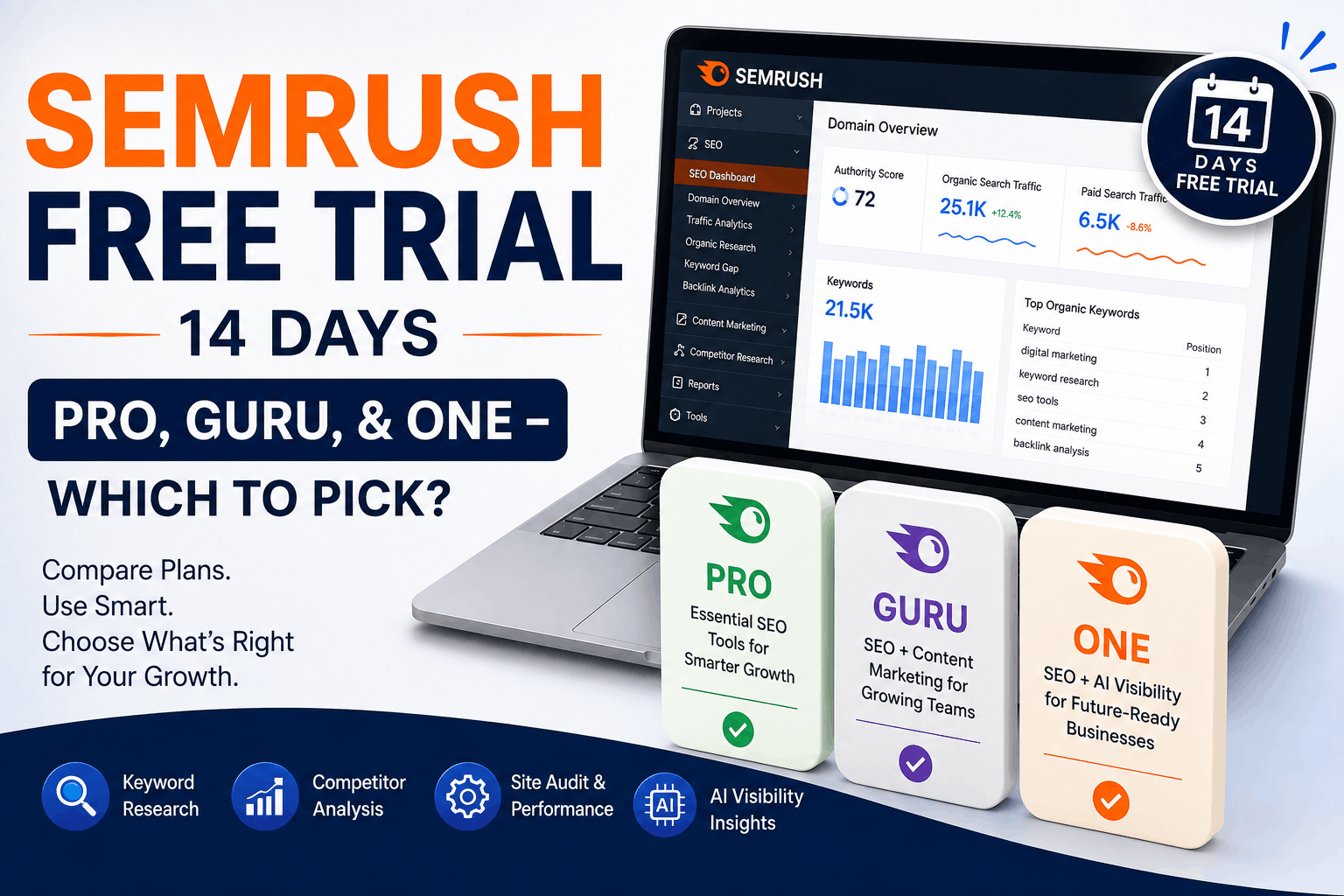
If you are planning to improve your website’s SEO, research keywords, analyze competitors, or understand how your brand is performing across search and AI platforms, a Semrush free trial can be a useful way to evaluate the platform before paying for a subscription.
However, Semrush offers different toolkits designed for different types of users. Choosing the right option depends on your business size, SEO requirements, content strategy, and long-term marketing goals.
A 7-day trial may seem like plenty of time, but it can pass quickly if you spend the entire period simply exploring dashboards and reports.
The smarter approach is to use the trial as a business evaluation period.
Your objective should be simple:
Find out whether Semrush can generate enough useful SEO and marketing insights to justify its cost.
Semrush 7-Day Trial: Quick Comparison
Semrush Pro
Best for: Freelancers, bloggers, website owners, startups, and small businesses.
Main focus: SEO, keyword research, competitor analysis, and website auditing.
What to evaluate: Keyword opportunities, competitor rankings, website issues, traffic insights, and potential SEO topics.
Our recommendation: A practical starting point if your primary objective is SEO.
Semrush Guru
Best for: Growing businesses, content marketers, bloggers, and small marketing teams.
Main focus: SEO combined with content marketing and deeper data.
What to evaluate: Historical data, content optimization, topic research, competitor analysis, and backlink insights.
Our recommendation: A strong option when content publishing is already an important part of your growth strategy.
Semrush One
Best for: Digital marketing agencies, larger marketing teams, and businesses focusing on both search and AI visibility.
Main focus: SEO, competitive research, and visibility across AI-powered search experiences.
What to evaluate: Keyword opportunities, competitors, AI brand visibility, AI mentions, and potential sources influencing your online visibility.
Our recommendation: Consider it if your marketing strategy goes beyond traditional Google search.
Semrush Pro Trial: What Can You Do in 7 Days?
Semrush Pro is primarily designed for users who want essential SEO capabilities without the complexity of larger plans.
It can be useful for:
- Freelancers
- Bloggers
- Website owners
- Startups
- Small businesses
- Businesses evaluating SEO as a growth channel
During your trial, don’t try to use every available feature.
Instead, concentrate on activities that can directly influence your business.
What You Can Accomplish
Within 7 days, you can use the trial period to:
- Research 2–3 important keyword clusters
- Analyze your main competitors
- Perform a complete website audit
- Identify keyword and content opportunities
- Understand the potential traffic behind important keywords
- Evaluate whether SEO could become a profitable long-term marketing channel
Keyword research should be connected to your business objectives.
For example, a keyword with thousands of monthly searches isn’t automatically valuable. A lower-volume keyword that attracts customers who are ready to purchase your service may be much more useful.
Who May Not Need Semrush Pro?
Semrush Pro may not be sufficient if you are:
- Managing several websites or clients
- Running a full-service digital marketing agency
- Dependent on extensive historical data
- Looking for advanced multi-channel marketing capabilities
For beginners and small businesses primarily focused on SEO, however, it can provide a useful starting point.
Semrush Guru Trial: When Should You Consider It?
Semrush Guru builds on the capabilities available in Pro and provides additional limits and features for users with more advanced content and SEO requirements.
It may be suitable for:
- Growing websites
- Content marketing teams
- Businesses publishing content regularly
- Bloggers with an established content strategy
- Marketing professionals managing multiple projects
The biggest advantage is that you can go beyond basic keyword research and start building a structured content strategy.
What Can You Do During the Trial?
You can use the trial period to:
- Develop a keyword strategy
- Build topic clusters
- Perform detailed competitor research
- Study historical website performance
- Analyze backlinks
- Identify content opportunities
- Improve existing content
What Are Topic Clusters?
A topic cluster is a group of related pages built around a central subject.
For example, if your main topic is Digital Marketing, you might create supporting content around:
- SEO
- Google Ads
- Meta Ads
- Keyword Research
- Google Business Profile
- Content Marketing
- Social Media Marketing
These pages can be connected through internal links to create a stronger topical structure.
This approach can help a website build authority around important subjects over time.
Who May Not Need Guru?
Guru can be unnecessary if you are:
- A beginner with limited SEO requirements
- A freelancer managing only one small website
- A small business with a very limited marketing budget
- Publishing content only occasionally
If your SEO and content operations are growing, however, the additional capabilities may make the upgrade worthwhile.
Explore Semrush and start your free trial
Semrush One Trial: SEO + AI Visibility
Digital search is changing.
People increasingly discover businesses through AI-powered experiences in addition to traditional search engines.
Semrush One is designed for organizations that want to evaluate both traditional SEO and newer AI visibility opportunities.
It may be more appropriate for:
- Digital marketing agencies
- In-house marketing teams
- Larger businesses
- Brands running multi-channel marketing campaigns
- Businesses interested in AI-driven visibility
What Can You Evaluate?
During the trial, you can explore:
- Keyword research
- Competitor performance
- AI brand mentions
- AI visibility
- Topics that may generate AI mentions
- Websites and sources influencing AI-generated answers
This makes the evaluation broader than traditional search rankings.
Instead of asking only:
“Where does my website rank on Google?”
you can also begin asking:
“How visible is my brand across modern AI-powered search experiences?”
That distinction is becoming increasingly important for businesses planning their long-term digital strategy.
Who May Not Need Semrush One?
Semrush One can be excessive for:
- Local small businesses with basic SEO requirements
- Individual bloggers
- Freelancers
- Businesses that only need traditional SEO
- Beginners who are still learning the fundamentals
If your immediate goal is simply to improve Google rankings, starting with a simpler SEO-focused plan may make more sense.
Common Mistakes People Make During a 7-Day Semrush Trial
A free trial should not become a 7-day tour of software dashboards.
The goal is to produce useful information that can support business decisions.
Here are some common mistakes to avoid.
1. Starting Without a Keyword Strategy
Don’t begin by randomly searching keywords.
First identify:
- Your main products or services
- Your target customers
- Your important locations
- Your commercial keywords
- Your informational topics
- Your competitors
Then use Semrush to validate your assumptions.
2. Trying Every Feature
More features don’t necessarily mean better results.
Select a few measurable objectives and focus your trial around them.
For example:
Goal: Find 20 profitable SEO keywords.
Then spend your time researching, evaluating, grouping, and prioritizing those keywords.
3. Forgetting to Export Your Research
If you decide not to continue with a paid subscription, make sure you save the useful research you have generated during the trial.
Depending on the tools available to you, this may include:
- Keyword lists
- Competitor data
- Backlink information
- Website audit findings
- Reports
- Content ideas
4. Upgrading Based on Emotion
Don’t upgrade simply because the software looks impressive.
Ask:
Will this subscription help my business generate enough value to justify the cost?
That is the more important question.
A Practical 7-Day Semrush Trial Strategy
Instead of spending two weeks exploring random features, follow a structured plan.
Day 1: Competitor Research
Start by identifying your major competitors.
Look for:
- Keywords they rank for
- Important pages
- Content topics
- Traffic opportunities
- Backlink sources
- Search visibility
The objective is to understand what is already working in your market.
Day 2: Keyword Mapping
Create a keyword map for your website.
Group keywords according to:
- Search intent
- Topic
- Product or service
- Location
- Funnel stage
For example:
Primary keyword → Supporting keywords → Target page → Search intent
This gives you a foundation for future SEO content.
Day 3: Content Planning
Use your keyword research to identify content opportunities.
Create a list of articles and pages that can target important searches.
Prioritize topics based on:
- Business relevance
- Search intent
- Competition
- Ranking potential
- Customer value
Don’t create content simply because a keyword has high search volume.
Create content because it can help your audience and your business.
Day 4: Content Optimization
Review your existing content and identify opportunities for improvement.
Look for:
- Missing keywords
- Weak headings
- Poor content structure
- Search intent mismatches
- Readability issues
- Missing supporting information
Your objective should be to make the page more useful to the visitor rather than simply adding keywords.
Day 5: Technical SEO Audit
Run a website audit and look for technical issues.
Depending on the report, these may include:
- Broken links
- Duplicate title tags
- Crawlability problems
- Technical SEO errors
- Missing metadata
- Other website health issues
Create a prioritized list.
Fix the problems that can have the greatest impact first.
Days 6-7: Reports and ROI Evaluation
At the end of your trial, organize your findings.
Review:
- Keywords discovered
- Competitor insights
- Technical issues
- Content opportunities
- Backlink opportunities
- Potential traffic opportunities
- AI visibility insights, if applicable
Then ask yourself:
Did Semrush uncover enough actionable opportunities to justify the subscription cost?
Remember that 7 days is generally too short to measure the complete impact of an SEO campaign.
SEO results often take considerably longer to develop.
The trial should therefore be used to evaluate the quality of the data and opportunities, rather than expecting your rankings or revenue to transform within two weeks.
Explore Semrush and start your free trial
Which Semrush Trial Should You Choose?
There is no single best Semrush plan for everyone.
Choose Pro if:
You are primarily interested in:
- SEO
- Keyword research
- Competitor analysis
- Website audits
- Basic SEO planning
Choose Guru if:
You need:
- More advanced SEO research
- Content marketing tools
- Topic planning
- Historical data
- Deeper content optimization
Choose One if:
Your strategy includes:
- SEO
- AI visibility
- Competitive intelligence
- Multi-channel marketing
- Long-term digital visibility
Final Thoughts
A Semrush trial should be treated as a business research project, not simply a free software experience.
Before starting, define what you want to discover.
For example:
“I want to identify 20 valuable keywords, analyze my five main competitors, audit my website, and create a three-month content plan.”
A clear objective makes the 7-day period much more valuable.
Whether you choose Pro, Guru, or One ultimately depends on the size of your website, your marketing strategy, and how deeply you need to use SEO and AI visibility data.
The right question isn’t:
“Which Semrush plan has the most features?”
It is:
“Which plan gives my business the data and insights I actually need?”
Shikshanest Digital helps learners, entrepreneurs, freelancers, and businesses understand practical digital marketing, SEO, Google Ads, Google Business Profile, keyword research, and other essential online-growth skills. Read this article: What Is SEO and How Does It Work to learn more about SEO and its uses in digital marketing.
Explore Semrush and start your free trial
Semrush Free Trial – Frequently Asked Questions
Can I cancel Semrush free trial?
Yes. Semrush allows users to cancel their free trial before it ends. According to Semrush’s current billing information, you can cancel a free trial during the trial period without being charged for the next subscription period. If you have started a trial with a payment method attached, it is important to cancel before the trial ends if you do not want the account to move into a paid subscription.
Is Semrush free trial without a credit card?
The payment requirements can depend on the specific Semrush trial or offer you are using. Semrush’s current documentation indicates that some trial activation processes involve a payment method, while its billing FAQ also notes that payment-method requirements can vary. Therefore, users should check the terms shown during the trial signup rather than assuming that every Semrush free trial is available without a credit card.
How to get Semrush free trial?
To get a Semrush free trial, visit the official Semrush website, choose the toolkit or plan you want to evaluate, and follow the trial signup process. Semrush currently offers free trials for several of its toolkits, including SEO, Semrush One, Traffic & Market, Local, Content, Social, Advertising, and AI PR, although availability and trial length can vary. Each toolkit trial is generally available once per account.
Before starting the trial, decide what you want to accomplish. For example, you could use the trial to research keywords, analyze competitors, audit your website, identify content opportunities, and evaluate whether Semrush provides enough value for your business.
How to cancel Semrush free trial?
To cancel a Semrush free trial, log in to your Semrush account and go to the Subscription Info section, or use Semrush’s cancellation process. Semrush states that cancellation requests can be submitted through its cancellation form. After submitting the request, you may need to confirm the cancellation through the email sent by Semrush.
If you are using a trial that automatically converts to a paid subscription, cancel before the trial ends if you want to avoid the subsequent charge. Semrush’s current refund and cancellation information specifically advises users to cancel before the trial period ends to avoid being charged.
Semrush free trial: how many days?
The length of a Semrush free trial depends on the specific toolkit or promotional offer. Semrush’s current official documentation says that most of its major toolkits offer a 7-day free trial. Some specific products or add-ons may have different trial periods, including 14-day offers.
Because trial offers can change, always check the trial period displayed on Semrush’s signup page before activating an offer.
Is Semrush worth trying for SEO?
If you are serious about keyword research, competitor analysis, technical SEO, content planning, or online visibility, a Semrush trial can be useful for evaluating the platform before committing to a paid plan.
Instead of simply exploring the available tools, create a short action plan. Research your most important keywords, analyze your competitors, audit your website, and identify realistic SEO opportunities. This will give you a much better understanding of whether Semrush is worth paying for your particular business or website.
1 thought on “Semrush Free Trial: Which Plan Should You Choose?”