
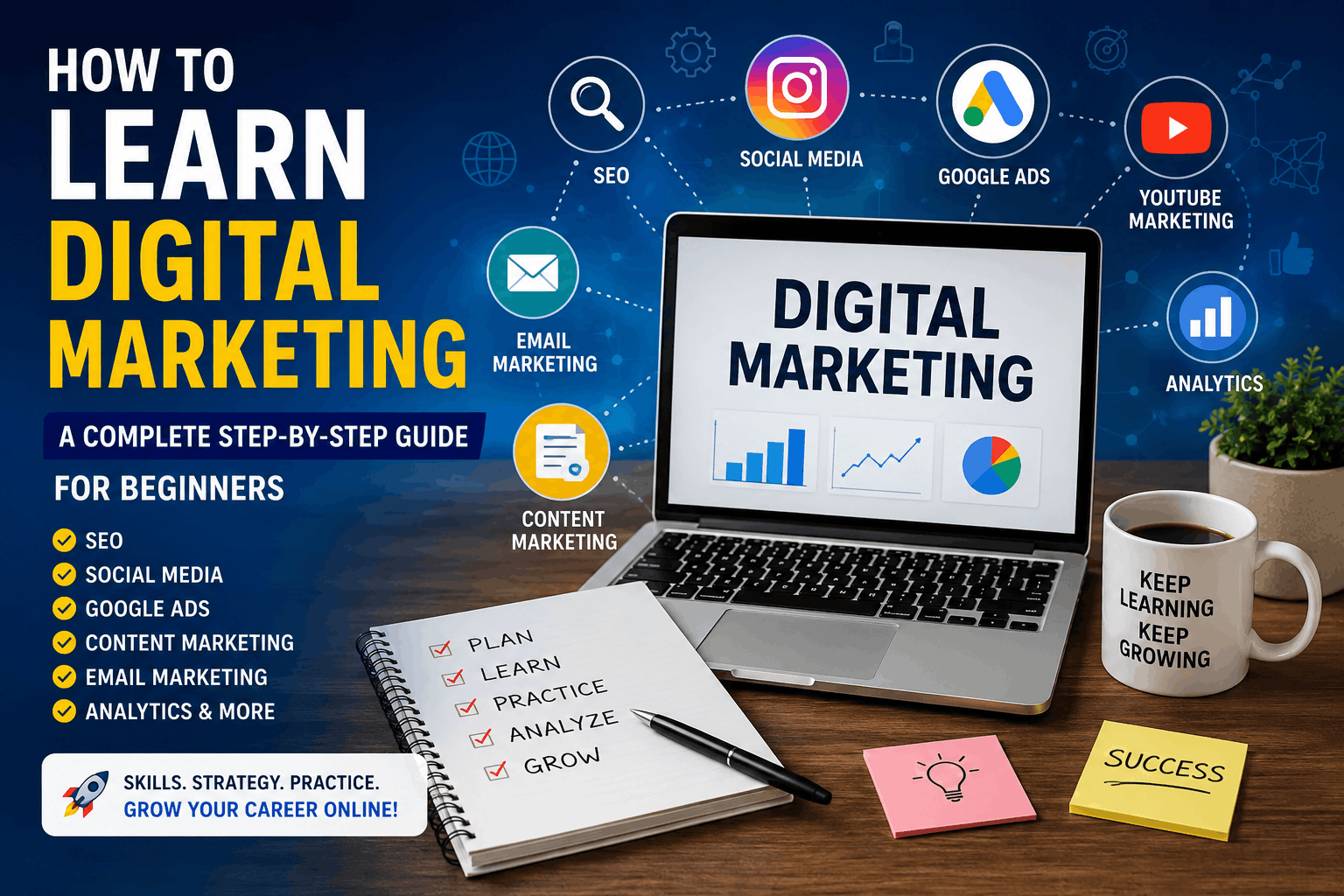
Digital marketing has become one of the most valuable skills in today’s business world. Whether you are a student, job seeker, freelancer, entrepreneur, business owner, or working professional, learning digital marketing can open the door to multiple career and business opportunities.
The good news is that you do not need a technical degree or years of experience to get started. With the right learning path, practical projects, consistent practice, and an understanding of modern digital platforms, you can gradually develop strong digital marketing skills.
But many beginners make one common mistake: they try to learn everything at once. SEO, social media, Google Ads, Meta Ads, email marketing, content marketing, analytics, affiliate marketing, websites, AI tools, and dozens of other topics can quickly become overwhelming.
The better approach is to learn digital marketing step by step.
In this guide, we will explain how to learn digital marketing from beginner to professional level, what skills you should learn, how to practise them, which tools are useful, how long it can take, and how you can turn your knowledge into a career or business.
What Is Digital Marketing?
Digital marketing is the process of promoting products, services, brands, or businesses through digital channels.
These channels can include:
- Search engines such as Google
- Social media platforms
- Websites and blogs
- Online advertising
- YouTube
- Mobile applications
- Online marketplaces
Unlike traditional marketing, digital marketing allows businesses to reach specific audiences, measure results, test different strategies, and make changes based on data.
For example, a local coaching institute can use Google Search, Instagram, Facebook, YouTube, WhatsApp, and its own website to attract students. An online store can use SEO and paid advertising to generate sales. A freelancer can use content marketing and social media to attract clients.
This is why digital marketing skills are useful across almost every industry.
Why Should You Learn Digital Marketing?
There are several reasons why digital marketing is an attractive skill to learn.
1. Growing Career Opportunities
Companies need people who can generate online visibility, leads, traffic, engagement, and sales. This creates opportunities for SEO executives, social media managers, digital advertising specialists, content marketers, email marketers, and digital marketing managers.
2. Freelancing Opportunities
Once you develop practical skills, you can provide services to businesses and individuals. You could offer SEO, social media management, Google Ads, Meta Ads, content creation, website optimization, or lead-generation services.
3. Start Your Own Business
Digital marketing is not only a job skill. Entrepreneurs can use it to promote their own products and services without depending entirely on traditional advertising.
4. Build a Personal Brand
You can use content, social media, YouTube, blogs, and other channels to establish yourself as an expert in your field.
5. Work Remotely
Many digital marketing activities can be performed online, making remote and freelance work possible.
Step 1: Understand the Fundamentals of Marketing
Before learning complicated tools, understand basic marketing concepts.
Learn about:
- Target audience
- Customer needs
- Buyer personas
- Value proposition
- Customer journey
- Marketing funnel
- Branding
- Lead generation
- Conversion
- Customer retention
- Return on investment (ROI)
For example, if you are promoting a digital marketing course, your target audience might include students, entrepreneurs, freelancers, job seekers, and small business owners.
You should understand who they are, what problem they have, and why your product or service can solve that problem.
This foundation makes every other digital marketing skill easier to understand.
Step 2: Learn How Websites Work
You do not need to become a professional web developer, but you should understand the basics of websites.
Learn concepts such as:
- Domain names
- Web hosting
- HTML basics
- Website structure
- Landing pages
- Forms
- Call-to-action buttons
- Mobile responsiveness
- Website speed
- Basic WordPress or CMS usage
A digital marketer frequently works with websites, so understanding how websites function is extremely useful.
You should also learn how to create a simple landing page and understand what makes a landing page effective.
Step 3: Learn Search Engine Optimization (SEO)
SEO is one of the most important digital marketing skills.
Search engine optimization is the process of improving a website or content so that it can appear more prominently in search engine results.
Start with these topics:
Keyword Research
Understand what people search for on Google and identify keywords relevant to your business.
On-Page SEO
Learn about:
- SEO titles
- Meta descriptions
- Headings
- URLs
- Internal links
- Image optimization
- Keyword placement
- Content structure
Technical SEO
Learn the basics of:
- Website speed
- Mobile usability
- Indexing
- Sitemaps
- Robots.txt
- Canonical URLs
- Structured data
Off-Page SEO
Understand backlinks, digital PR, citations, and authority building.
Do not simply memorize SEO techniques. Create a website or blog and practise SEO on real pages.
Step 4: Learn Content Marketing
Content is one of the foundations of digital marketing.
Businesses use content to attract potential customers, educate them, build trust, and encourage conversions.
Learn how to create:
- Blog articles
- Social media posts
- Videos
- YouTube scripts
- Infographics
- Case studies
- Email newsletters
- Landing page copy
Learn the difference between content that simply receives views and content that helps achieve a business objective.
A good digital marketer should always ask:
What is the purpose of this content?
Is it designed to generate awareness, traffic, leads, engagement, or sales?
Social media is another major area of digital marketing.
Start by understanding platforms such as:
- YouTube
- X
You do not need to become an expert on every platform immediately.
Choose one or two platforms relevant to your target audience and learn:
- Content planning
- Post creation
- Captions
- Hashtags
- Reels and short-form videos
- Community engagement
- Social media analytics
- Organic growth
- Social media strategy
The key is to practise. Create a test page or use your own business profile and publish content consistently.
Step 6: Learn Google Ads and Paid Advertising
Organic marketing takes time. Paid advertising can help businesses reach potential customers faster.
Learn the fundamentals of:
- Search advertising
- Display advertising
- YouTube advertising
- Keyword targeting
- Audience targeting
- Ad copy
- Landing pages
- Conversion tracking
- Campaign budgets
- Cost per click (CPC)
- Cost per lead (CPL)
- Return on ad spend (ROAS)
Start with the theory before spending significant money.
When you eventually run campaigns, start with a small controlled budget and measure the results carefully.
Step 7: Learn Meta Ads
Facebook and Instagram advertising are important for many businesses.
Learn:
- Campaign objectives
- Audience targeting
- Custom audiences
- Retargeting
- Creative testing
- Ad formats
- Lead-generation campaigns
- Conversion campaigns
- Campaign performance analysis
One important lesson is that advertising is not simply about pressing the “Boost” button.
Professional advertising requires a clear objective, audience, creative strategy, offer, landing page, tracking system, and measurement process.
Step 8: Learn Email and WhatsApp Marketing
Email marketing remains useful for nurturing leads and customers.
Learn how to create:
- Welcome emails
- Promotional campaigns
- Follow-up sequences
- Newsletters
- Abandoned-cart messages
- Customer retention campaigns
You should also understand permission, privacy, and responsible messaging practices.
For businesses that communicate with customers through WhatsApp, learn how approved business messaging, templates, customer conversations, and automation work.
Step 9: Learn Analytics and Data
A digital marketer should not rely only on likes and followers.
You need to understand numbers.
Learn metrics such as:
- Website traffic
- Sessions
- Users
- Engagement rate
- Click-through rate
- Conversion rate
- Cost per click
- Cost per lead
- Customer acquisition cost
- Return on investment
- Return on ad spend
Tools such as Google Analytics and Google Search Console can help you understand website and search performance.
The most important question is not:
“How many people saw my post?”
It is:
“What business result did this marketing activity produce?”
Step 10: Learn AI Tools for Digital Marketing
Artificial intelligence is changing how digital marketers work.
AI tools can help with:
- Brainstorming
- Keyword research
- Content ideas
- Drafting
- Ad copy variations
- Social media planning
- Data analysis
- Customer communication
- Video concepts
- Image generation
- Marketing automation
However, AI should be treated as a productivity tool rather than a replacement for marketing knowledge.
A marketer who understands customers, strategy, positioning, analytics, and conversion can use AI much more effectively than someone who simply generates content with AI.
Step 11: Build Your Own Digital Marketing Project
This is perhaps the most important step.
Do not spend months only watching tutorials.
Create something real.
You could create:
- A personal blog
- A YouTube channel
- An Instagram page
- A small e-commerce project
- A local business website
- An affiliate website
- A portfolio website
- A small online service business
Then apply what you learn.
For example, create a website and publish ten articles. Perform keyword research, optimize the articles, create social media posts, track traffic, and improve the pages based on data.
This practical experience will teach you far more than simply watching dozens of courses.
Step 12: Create a Digital Marketing Portfolio
If you want a job or freelance clients, create a portfolio.
Your portfolio can include:
- SEO projects
- Social media campaigns
- Blog articles
- Google Ads projects
- Meta Ads examples
- Landing pages
- Analytics reports
- Content calendars
- Marketing strategies
- Case studies
You don’t necessarily need famous clients.
A well-documented personal project can demonstrate your ability to research, execute, analyse, and improve a campaign.
For example:
Project: Local Coaching Institute Marketing Campaign
Objective: Generate student enquiries.
Strategy: SEO + Google Business Profile + Instagram + Google Ads.
Result: Increased website traffic and generated qualified enquiries.
The ability to explain what you did, why you did it, and what happened makes a portfolio much stronger.
How Long Does It Take to Learn Digital Marketing?
There is no fixed answer because digital marketing is a large field.
A realistic learning progression could look like this:
Month 1: Marketing fundamentals, websites, content, and social media.
Month 2: SEO and keyword research.
Month 3: Google Ads, Meta Ads, and analytics.
Month 4: Email marketing, WhatsApp marketing, conversion optimization, and advanced strategy.
Month 5 onward: Real projects, specialization, freelancing, internships, or employment.
You can learn the basics within a few months, but becoming highly skilled requires continuous practice.
Digital marketing changes frequently, so professional marketers must keep learning.
Should You Learn Everything or Specialize?
Initially, learn the basics of all major areas.
After that, choose a specialization.
For example, you could specialize in:
- SEO
- Performance marketing
- Social media marketing
- Content marketing
- Email marketing
- E-commerce marketing
- Local SEO
- YouTube marketing
- Marketing analytics
Specialization can make it easier to position yourself as an expert.
For example, instead of saying:
“I do digital marketing.”
you could say:
“I help local businesses generate leads through SEO and Google Ads.”
The second statement is much more specific.
Common Mistakes Beginners Should Avoid
Trying to Learn Everything at Once
Digital marketing is huge. Follow a structured learning path.
Only Watching Videos
Knowledge without implementation will not build professional skills.
Chasing Certificates
Certificates can demonstrate learning, but employers and clients also want practical ability.
Spending Too Much on Advertising
Learn campaign fundamentals before investing significant money.
Ignoring Analytics
Without measurement, you cannot know what is working.
Copying Other Marketers
Study successful campaigns, but develop your own understanding and strategy.
Using AI Without Reviewing Content
Always fact-check, edit, and improve AI-generated material.
How Can You Earn After Learning Digital Marketing?
Once you have practical skills, there are several possible career paths.
You can apply for jobs such as:
- Digital Marketing Executive
- SEO Executive
- Social Media Manager
- Performance Marketing Executive
- Content Marketing Executive
- PPC Specialist
- Digital Marketing Manager
You can also work independently as a freelancer or start your own digital marketing agency.
Another option is to use digital marketing to grow your own business.
This last option is particularly powerful because you are not only selling marketing services—you are using marketing to create your own customers and revenue.
A Simple Digital Marketing Learning Roadmap
If you are completely new, follow this sequence:
Step 1: Learn marketing fundamentals.
Step 2: Understand websites and landing pages.
Step 3: Learn content marketing.
Step 4: Learn social media marketing.
Step 5: Learn SEO.
Step 6: Learn Google Ads.
Step 7: Learn Meta Ads.
Step 8: Learn email and WhatsApp marketing.
Step 9: Learn analytics.
Step 10: Learn AI-powered marketing tools.
Step 11: Build real projects.
Step 12: Create your portfolio.
Step 13: Start applying for jobs, internships, freelance projects, or clients.
Final Thoughts
Learning digital marketing is not about memorizing hundreds of tools or watching endless tutorials. It is about understanding people, creating valuable content, reaching the right audience, generating interest, converting prospects, and measuring results.
The best way to learn is to combine knowledge + practice + experimentation + analysis.
Start small. Choose one project. Learn one skill at a time. Apply what you learn immediately. Track your results and improve continuously.
If you are looking for a structured way to learn digital marketing, a practical course or masterclass can help you avoid the confusion of jumping between unrelated tutorials. But regardless of whether you learn through a course, books, videos, mentors, or self-study, your biggest advantage will always be consistent practical experience.
Digital marketing is a constantly evolving field. Platforms change, algorithms change, advertising systems change, and new AI tools appear regularly. Therefore, becoming a successful digital marketer is not about reaching a point where you stop learning.
It is about developing the ability to learn, test, measure, adapt, and grow.
Start today with one small project. Build your first campaign, publish your first article, create your first landing page, or analyse your first set of marketing data.
Your first project may not be perfect—and it doesn’t need to be.
The fastest way to learn digital marketing is to start doing digital marketing.
1 thought on “How to Learn Digital Marketing: A Complete Step-by-Step Guide for Beginners”