
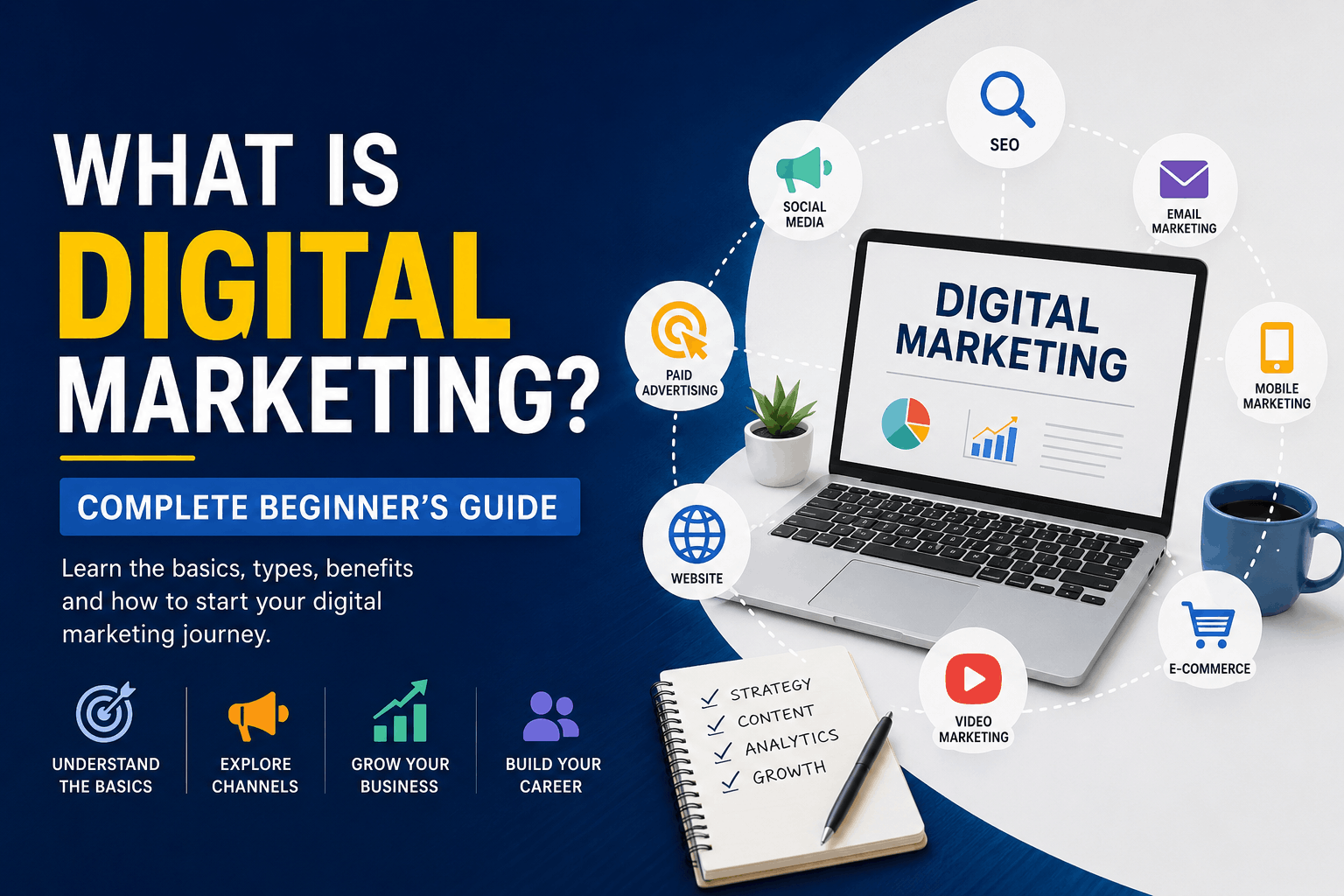
Digital marketing has become one of the most important ways for businesses, creators, professionals and entrepreneurs to reach people online. From a small local business using Instagram to a global company running Google Ads, almost every modern organization uses some form of digital marketing.
But what exactly is digital marketing? How does it work? What are its different types? Which skills should a beginner learn? And how can you start a career or business in digital marketing?
This complete beginner’s guide from Shikshanest Digital explains digital marketing in simple language and provides a practical roadmap for getting started.
What Is Digital Marketing?
Digital marketing is the process of promoting products, services, brands or ideas using digital channels and technologies.
These channels can include:
- Search engines such as Google
- Websites and blogs
- Social media platforms
- Online advertising
- YouTube
- Mobile applications
- Messaging platforms
- Online communities
In simple terms:
Digital marketing means using the internet and digital technologies to reach the right people, communicate with them and encourage them to take an action.
That action could be:
- Visiting a website
- Making a purchase
- Calling a business
- Sending an enquiry
- Downloading a resource
- Registering for a course
- Subscribing to a newsletter
- Following a social media account
For example, when you search Google for “digital marketing course near me” and see a course provider at the top of the search results, that visibility may be the result of SEO or paid search advertising.
When you see a sponsored Instagram post promoting a product, that is social media advertising.
When you receive an email offering a discount on a course, that is email marketing.
All of these activities fall under the broad area of digital marketing.
Why Is Digital Marketing Important?
The way people discover products and services has changed dramatically.
Before the internet became central to everyday life, businesses depended heavily on newspapers, television, radio, billboards, brochures, direct sales and other traditional channels.
Today, customers often begin their journey online.
They may:
- Search Google for a solution.
- Watch YouTube videos.
- Compare products online.
- Read reviews.
- Check Instagram or Facebook.
- Visit a company’s website.
- Ask questions through WhatsApp.
- Finally, make a purchase.
Digital marketing allows businesses to participate in this journey.
It can also be more measurable than many traditional marketing methods.
A business can often track metrics such as:
- Website visitors
- Clicks
- Leads
- Conversion rates
- Advertising costs
- Sales
- Customer acquisition costs
- Return on advertising spend
This data helps marketers understand what is working and what needs improvement.
How Does Digital Marketing Work?
Digital marketing is not simply about posting on social media or running advertisements.
A successful digital marketing strategy generally involves several stages.
1. Understanding the Audience
First, you need to understand who you want to reach.
For example, a digital marketing course might target:
- College students
- Working professionals
- Entrepreneurs
- Freelancers
- Business owners
Each audience has different needs and motivations.
2. Creating the Right Offer
The next step is deciding what you are offering.
It could be:
- A product
- A service
- A course
- A consultation
- A free resource
- A subscription
3. Reaching the Audience
You then use appropriate digital channels such as:
- Social media
- YouTube
- Websites
- Online advertising
4. Converting Visitors
Getting people to your website is not enough.
You need to encourage them to take the desired action.
This could involve:
- A clear landing page
- Strong content
- Testimonials
- Calls to action
- Offers
- Contact options
- Easy checkout
5. Measuring Results
Finally, you analyse the results.
For example:
1000 website visitors → 100 enquiries → 20 customers
The marketer can then investigate where improvements can be made.
This process of attracting, converting and retaining customers is at the heart of digital marketing.
Major Types of Digital Marketing
Digital marketing includes many different specializations.
1. Search Engine Optimization (SEO)
SEO is the process of improving a website’s visibility in organic search engine results.
For example, imagine you publish an article called:
“How to Start Digital Marketing in India”
Someone searches Google for that topic.
If your page appears prominently in the search results, you can potentially receive visitors without paying for every click.
SEO generally involves areas such as:
- Keyword research
- Content optimization
- On-page SEO
- Technical SEO
- Internal linking
- Website performance
- Authority and backlinks
- Search intent
SEO is particularly valuable for bloggers and businesses because high-quality content can continue attracting organic traffic over time.
2. Search Engine Marketing and Paid Advertising
Businesses can also pay to appear in search results and across digital advertising networks.
Google Ads is one of the most widely known examples.
For instance, a business selling digital marketing courses might create an advertisement targeting searches related to digital marketing training.
Paid advertising can help businesses reach potential customers quickly, but it requires careful management of:
- Targeting
- Budget
- Keywords
- Ad copy
- Landing pages
- Conversion tracking
- Bidding strategies
Social media marketing involves using platforms such as Instagram, Facebook, LinkedIn, YouTube and other social networks to build awareness, engagement and business results.
Social media marketing can include:
- Organic posts
- Reels
- Short videos
- Stories
- Educational content
- Community engagement
- Influencer collaborations
- Paid advertising
For example, a tutor might use Instagram to publish educational videos and attract students.
A business might use LinkedIn to generate B2B leads.
A creator might use YouTube to build an audience and sell courses.
4. Content Marketing
Content marketing focuses on creating useful content that attracts and educates an audience.
Content can include:
- Blog articles
- Videos
- Podcasts
- Guides
- E-books
- Infographics
- Case studies
- Tutorials
- Social media posts
The goal is not always to sell immediately.
Instead, valuable content can help build:
Attention → Trust → Relationship → Conversion
For example, someone might discover a company through a useful Google article, subscribe to its newsletter, attend a webinar and eventually purchase its course.
5. Email Marketing
Email marketing involves communicating with customers or subscribers through email.
Businesses can use email for:
- Newsletters
- Product announcements
- Educational content
- Offers
- Course updates
- Customer communication
- Lead nurturing
One major advantage of email marketing is that businesses can develop a direct communication channel with their audience rather than depending entirely on social media algorithms.
6. Affiliate Marketing
Affiliate marketing is a performance-based marketing model.
A publisher or creator recommends a product or service using a special tracking link.
If a user purchases through that link, the affiliate may receive a commission.
For example, a digital marketing blog might publish:
“Best SEO Tools for Beginners”
The article could include affiliate links to relevant tools.
Affiliate marketing can become a source of website revenue when combined with quality content and targeted traffic.
However, affiliate relationships should always be disclosed transparently.
7. Influencer Marketing
Influencer marketing involves working with individuals who have an audience on platforms such as Instagram, YouTube or other social networks.
A brand may collaborate with a creator to promote a product or service.
Influencer marketing can work particularly well when the creator’s audience closely matches the company’s target customers.
8. Video Marketing
Video has become an important part of digital marketing.
Businesses and creators can use:
- YouTube videos
- YouTube Shorts
- Instagram Reels
- Facebook videos
- Educational webinars
- Product demonstrations
- Testimonials
Video allows businesses to explain complex topics visually and build familiarity with their audience.
For an educator, video can be especially powerful because teaching itself becomes a form of marketing.
9. Mobile and Messaging Marketing
Many customers interact with businesses through mobile devices and messaging platforms.
Businesses may use:
- SMS
- Mobile apps
- Push notifications
- Mobile-friendly websites
Messaging can be particularly useful for enquiries, reminders, customer support and transactional communication.
However, businesses should always follow applicable laws, platform policies and consent requirements.
10. Conversion Rate Optimization
Getting visitors to your website is only one part of marketing.
Conversion Rate Optimization, or CRO, focuses on improving the percentage of visitors who take a desired action.
For example:
If 1,000 people visit a course page and 20 purchase the course, the conversion rate is 2%.
A marketer may test:
- Headlines
- Images
- Pricing presentation
- Testimonials
- Calls to action
- Page layout
- Forms
- Offers
The objective is to improve the visitor-to-customer journey.
Digital Marketing Funnel
A useful way to understand digital marketing is through the concept of a marketing funnel.
Awareness
People first discover your brand.
Channels might include:
- YouTube
- Blog articles
Interest
They become interested and consume your content.
For example, they may read an article or watch a video.
Consideration
They compare your product or service with alternatives.
They may read reviews, visit your pricing page or attend a webinar.
Conversion
They take an action such as:
- Purchasing
- Registering
- Booking a consultation
- Enquiring
Retention
After the purchase, you continue providing value and support.
Advocacy
Satisfied customers may recommend your business to others.
This creates a cycle where customers can become sources of new growth.
Digital Marketing vs Traditional Marketing
Traditional marketing includes channels such as:
- Television
- Radio
- Newspapers
- Magazines
- Billboards
- Print advertising
Digital marketing uses:
- Search engines
- Websites
- Social media
- Online advertising
- Video
- Digital communities
The biggest difference is not simply “online versus offline.”
Digital marketing often provides greater opportunities for:
- Detailed targeting
- Measurement
- Real-time optimization
- Audience segmentation
- Interaction
- Personalization
However, traditional marketing can still be effective depending on the audience, industry and objective.
The best marketing strategy may combine both.
Skills Required for Digital Marketing
You do not need to master everything immediately.
A beginner can start with foundational skills such as:
Marketing Fundamentals
Understand:
- Target audience
- Customer needs
- Value proposition
- Branding
- Marketing funnels
Content Skills
Learn how to:
- Write clearly
- Create useful content
- Write headlines
- Create social media posts
- Develop video ideas
SEO
Learn:
- Keywords
- Search intent
- On-page SEO
- Technical basics
- Content optimization
Analytics
Understand basic metrics such as:
- Traffic
- Click-through rate
- Conversion rate
- Cost per lead
- Customer acquisition cost
Advertising
Learn the fundamentals of platforms such as:
- Google Ads
- Meta Ads
AI
Modern marketers can also benefit from learning how to use AI tools for:
- Research
- Content ideas
- Data analysis
- Copywriting assistance
- Automation
- Productivity
The key is not simply knowing how to use tools, but understanding why and when to use them.
How to Start Learning Digital Marketing
If you’re a complete beginner, don’t try to learn everything at once.
Follow a structured roadmap.
Step 1: Learn Marketing Fundamentals
Understand customers, markets, offers and positioning.
Step 2: Learn Content Marketing
Start creating useful content.
Step 3: Learn SEO
Understand how people discover content through search engines.
Understand content formats, engagement and platform-specific strategies.
Step 5: Learn Paid Advertising
Study Google Ads and Meta Ads fundamentals.
Step 6: Learn Analytics
Understand how to measure results.
Step 7: Learn AI Tools
Use AI to improve productivity and marketing workflows.
Step 8: Practice
Create your own website, social media page or small project.
Step 9: Build a Portfolio
Document what you create and what you learn.
Step 10: Start Applying
You can use your skills for:
- Your own business
- Freelancing
- Employment
- Consulting
- Content creation
- Affiliate marketing
- Online courses
Can You Make Money With Digital Marketing?
Yes, digital marketing skills can create several career and business opportunities.
You can work as a:
- SEO specialist
- Social media manager
- Content marketer
- PPC specialist
- Digital marketing executive
- Email marketer
- Marketing analyst
- Affiliate marketer
- Freelance digital marketer
- Digital marketing consultant
You can also use digital marketing to grow your own business.
However, learning digital marketing does not automatically guarantee income.
The ability to generate income depends on your skills, experience, portfolio, ability to solve problems and ability to create measurable value.
How Businesses Use Digital Marketing
Almost every industry can benefit from digital marketing.
For example:
Education
Schools, tutors and course providers can use SEO, social media, content and advertising to attract learners.
Real Estate
Agents can use websites, Google Ads, social media and lead-generation campaigns.
Healthcare
Organizations can use websites, search visibility and educational content to reach audiences, subject to applicable regulations.
E-commerce
Online stores can combine SEO, paid advertising, social media, email and remarketing.
Local Businesses
Restaurants, salons, gyms, consultants and other businesses can use local SEO, Google Business Profile, social media and messaging.
Common Digital Marketing Mistakes Beginners Make
1. Trying Everything at Once
Focus on a few skills first.
2. Creating Content Without Understanding the Audience
Content should solve a real problem.
3. Focusing Only on Followers
Followers are not the same as customers.
4. Ignoring SEO
Great content can be difficult to discover without search optimization.
5. Running Ads Without Tracking
Advertising without measurement can waste money.
6. Copying Competitors
Study competitors, but develop your own value proposition.
7. Expecting Instant Results
SEO, content marketing and brand building often require consistency.
8. Not Practicing
Digital marketing is a practical skill.
Reading alone is not enough.
The Future of Digital Marketing
Digital marketing is evolving quickly.
Artificial intelligence, automation, personalization, short-form video, creator marketing, search evolution and data-driven decision-making are changing how businesses reach customers.
AI is becoming particularly important.
Marketers can use AI to assist with:
- Research
- Content ideation
- Data analysis
- Customer segmentation
- Campaign planning
- Workflow automation
- Creative development
But technology does not eliminate the need for marketing fundamentals.
A marketer still needs to understand:
People → Problems → Offers → Communication → Distribution → Measurement
Tools can help you execute faster, but strategic thinking remains important.
Frequently Asked Questions
Is digital marketing difficult to learn?
Digital marketing has many areas, so it can initially feel overwhelming. However, beginners can start with fundamentals and gradually specialize.
How long does it take to learn digital marketing?
The fundamentals can be learned relatively quickly, but becoming highly skilled requires continuous practice and experience.
Can I learn digital marketing from home?
Yes. There are many online resources, courses, tutorials and practical projects that can help you learn from home.
Do I need coding knowledge?
No. Basic digital marketing does not require programming knowledge. However, understanding basic HTML, websites and technical concepts can be useful, especially for SEO.
Is digital marketing a good career?
Digital marketing can offer opportunities across employment, freelancing, consulting and entrepreneurship. Your success depends on developing practical skills and being able to demonstrate results.
Can small businesses use digital marketing?
Absolutely. Small businesses can use SEO, social media, content, Google Business Profile, email, messaging and paid advertising depending on their goals and budget.
Final Thoughts
Digital marketing is much more than posting on Instagram or running advertisements.
It is a complete ecosystem involving marketing strategy, content, search engines, social media, advertising, email, websites, analytics, AI and customer relationships.
The good news is that you don’t need to master everything at once.
Start with the fundamentals.
Learn one skill at a time.
Practice on real projects.
Measure your results.
Build a portfolio.
Then gradually expand your expertise.
The digital economy continues to evolve, and people who combine marketing knowledge with practical digital skills can create opportunities across careers, freelancing, entrepreneurship and online business.
At Shikshanest Digital, our goal is to make this journey easier by providing practical articles, tutorials, resources and structured learning programs.
Ready to Start Learning Digital Marketing?
Explore more digital marketing guides and practical resources on Shikshanest Digital.
If you want structured, practical training, explore our Shikshanest Digital Academy courses and masterclasses.
Learn Digital. Build Skills. Grow Online.
About Shikshanest Digital
Shikshanest Digital is a digital learning and knowledge platform from Shikshanest, providing practical content, courses, tutorials, resources and insights covering digital marketing, AI, SEO, social media, online business and other digital skills.