
If you are learning digital marketing or trying to improve the visibility of a website on Google, you will frequently come across the term backlinks. Backlinks are one of the most important parts of search engine optimization (SEO), particularly when it comes to building a website’s authority, credibility, and organic search visibility. Let’s learn what are seo backlinks in SEO to enhance our digital marketing knowledge.
But what exactly is a backlink? Why are backlinks important for SEO? How do backlinks affect Google rankings? What is the difference between backlinks and internal links? And how can beginners learn how to create backlinks in SEO without using risky techniques?
In this detailed guide, we will explain backlinks in simple language, discuss search engine optimization link building, explore different types of backlinks, and explain how businesses can develop a sustainable link-building strategy to provide you with better knowledge about seo.
If you are interested in learning SEO, Google Ads, Meta Ads, content marketing, social media marketing, and other practical skills, you can also consider learning digital marketing through Shikshanest Digital.
What Are Backlinks in SEO?
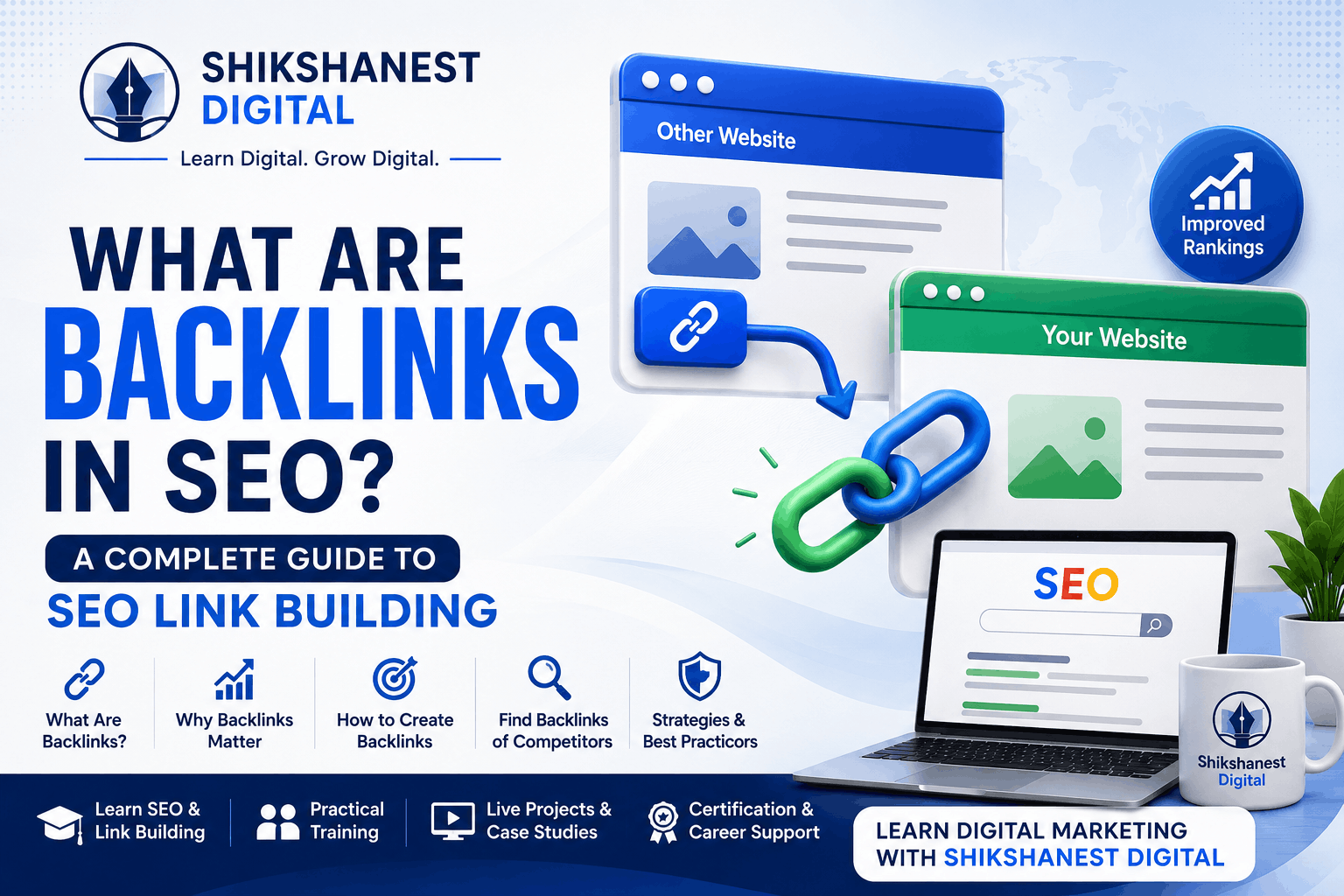
A backlink is a hyperlink from one website to another website.
For example, suppose Website A publishes an article about online education and includes a link to a useful article on Website B. That link from Website A to Website B is called a backlink for Website B.
In simple terms:
Backlink = A link from another website pointing to your website.
Backlinks are also called inbound links or incoming links.
Search engines can use backlinks as one of the signals for understanding the popularity, relevance, authority, and credibility of webpages. However, not every backlink has the same value.
A link from a trusted, relevant website can potentially be much more valuable than hundreds of low-quality links from unrelated or spammy websites.
This is why modern SEO focuses not simply on getting as many backlinks as possible, but on earning relevant, trustworthy, and natural backlinks.
Why Are Backlinks Important in SEO?
Backlinks have historically played an important role in SEO because search engines can use links to discover webpages and understand relationships between websites.
Imagine that several respected websites independently recommend the same resource. That recommendation can provide useful context about the resource’s importance.
Backlinks can help with:
- Website authority
- Search engine discovery
- Referral traffic
- Brand visibility
- Content distribution
- Online reputation
- SEO performance
- Building relationships with other websites
However, backlinks are only one part of SEO.
A website can have thousands of backlinks and still perform poorly if its content is weak, its technical SEO is poor, or its pages do not satisfy search intent.
Therefore, backlinks should be considered as part of a broader SEO strategy.
How SEO Works for Websites
Before understanding link building, it is important to understand how SEO works for websites.
Search engine optimization involves improving a website so that search engines can better crawl, understand, index, and rank its pages for relevant searches.
SEO generally includes several major areas:
- Keyword research
- Search intent analysis
- Content optimization
- Technical SEO
- On-page SEO
- Off-page SEO
- Link building
- Website performance
- User experience
- Content authority
When a person searches Google for something such as “best digital marketing course,” Google evaluates numerous signals to determine which pages are most useful for that search.
Backlinks can contribute to the authority side of SEO, while content and on-page optimization help search engines understand what a page is about.
This is why successful SEO requires a combination of different techniques rather than focusing only on backlinks.
What Is Search Engine Optimization Link Building?
Search engine optimization link building is the process of acquiring links from other websites to your website in a natural and strategic way.
The objective is not simply to collect links.
The objective is to earn links that make sense because another website considers your content useful, informative, authoritative, or relevant to its audience.
For example, a digital marketing website may publish a detailed guide about SEO. A marketing blog could discover that guide and naturally reference it in an article about SEO strategies.
That editorial reference can become a valuable backlink.
Good link building usually focuses on:
- Relevance
- Authority
- Quality
- Natural placement
- Useful content
- Editorial value
- Relationship building
How to Create Backlinks in SEO
If you want to understand how to create backlinks in SEO, start by thinking about why another website would want to link to your content.
The easiest way to earn quality backlinks is to create something worth referencing.
Here are some practical methods.
1. Create High-Quality Content
Useful content is the foundation of sustainable link building.
You can create:
- Detailed guides
- Original research
- Case studies
- Statistics pages
- Tutorials
- Industry reports
- Infographics
- Expert interviews
- Helpful tools
- Comprehensive resources
If your content solves a genuine problem, other websites have a reason to reference it.
2. Guest Contributions
Contributing useful articles to relevant websites can help you reach new audiences and, where editorially appropriate, earn links.
However, guest posting should not become a process of publishing low-quality articles solely to manipulate rankings.
Focus on publishing genuinely useful content on relevant websites.
3. Digital PR
Digital PR involves creating stories, research, opinions, surveys, reports, or other assets that journalists, publications, bloggers, and industry websites may want to reference.
A successful digital PR campaign can generate both brand exposure and high-quality backlinks.
4. Business Directories
Relevant and reputable business directories can provide useful citations and links, especially for local businesses.
However, businesses should avoid submitting websites to hundreds of poor-quality directories to obtain backlinks.
5. Resource Pages
Some websites maintain resource pages containing useful links for their audience.
If you have genuinely valuable content that fits the resource page, you can contact the website owner and suggest it.
6. Broken Link Building
Broken link building involves identifying relevant broken links on websites and suggesting a useful replacement resource.
The important part is relevance and usefulness rather than sending mass automated emails.
What Is a Backlink in Digital Marketing?
A backlink in digital marketing is more than an SEO signal.
It can also be a source of referral traffic and brand awareness.
Suppose a popular education website publishes an article about learning digital marketing and links to an educational platform. Readers may click that link and visit the platform.
Therefore, a good backlink can potentially provide two benefits:
SEO value + referral traffic
This is one reason why digital marketers should evaluate links from a broader marketing perspective rather than considering only their effect on rankings.
Types of Backlinks
There are different ways to classify backlinks.
Editorial Backlinks
These occur naturally when a website references your content because it is useful to its readers.
These are generally among the most desirable types of links.
Guest Post Links
These are links included in content contributed to another website. Their value depends heavily on the quality, relevance, editorial standards, and circumstances of the publication.
Business Profile Links
Businesses may have links in legitimate business profiles or directories.
These can be useful for brand visibility and local SEO when the platform is reputable and relevant.
Resource Links
A website may link to your content as a useful resource for its visitors.
Nofollow and Sponsored Links
Some links contain attributes that tell search engines not to treat the link as a conventional editorial endorsement.
For example, sponsored links should be appropriately identified.
The important lesson is that SEO is not about manipulating link attributes. It is about building a credible online presence.
Find Backlinks of Competitors
One useful SEO research activity is to find backlinks of competitors.
Competitor backlink analysis can help you understand:
- Which websites mention competitors
- Which content attracts links
- Which publications cover your industry
- Which resource pages exist
- Which websites may be relevant to your brand
- What kinds of content competitors are promoting
For example, if you operate an education website and discover that several education blogs link to a competitor’s comprehensive guide, you can study why that content attracts links.
You can then create a better, more useful resource rather than simply copying the competitor.
Popular SEO platforms provide backlink analysis tools that can help marketers investigate competitor link profiles.
The purpose of competitor research should be to discover opportunities and understand the market—not to blindly replicate every backlink.
Link Building Services: What Do They Offer?
Many businesses do not have an in-house SEO team, so they consider link building services.
Professional link-building providers may offer services such as:
- Backlink research
- Competitor backlink analysis
- Content outreach
- Digital PR
- Guest-content outreach
- Resource-page outreach
- Link opportunity research
- Website prospecting
- Link monitoring
However, businesses should carefully evaluate any company offering link-building services.
Be cautious of providers promising:
- Thousands of backlinks within a few days
- Guaranteed Google rankings
- Instant authority
- Completely automated backlinks
- Large quantities of links at extremely low prices
SEO does not work like buying a fixed number of guaranteed ranking points.
Quality, relevance, content, technical SEO, competition, and search intent all matter.
What are seo backlinks examples
SEO backlinks are links from other websites to your website. They can help improve your website’s authority, visibility, and search rankings when they come from relevant, trustworthy sources. Examples: guest post links, business directory listings, educational website references, blog mentions, and links from industry-related websites.
Example 1: Best Affiliate Programs in India ( This is an Internal seo backlink )
Example 2: How to grow YouTube channel ( This is an external seo backlink)
SEO Link Building Services vs. SEO Backlink Building Services
You may see agencies using terms such as SEO link building services and SEO backlink building services.
In most cases, these terms refer to activities designed to acquire inbound links for a website.
The terminology is less important than the methodology.
Before hiring an SEO provider, ask:
- How do you identify link opportunities?
- Do you focus on relevant websites?
- How do you evaluate website quality?
- Do you create original content?
- Do you use outreach?
- Do you follow search engine guidelines?
- Will you provide a report?
- Do you guarantee rankings?
A professional provider should be able to explain its process clearly.
Off Page Optimization in Digital Marketing
Backlinks are strongly connected with off page optimization in digital marketing.
Off-page SEO refers to activities performed outside your own website that can influence your website’s visibility, reputation, authority, or discovery.
These activities can include:
- Link building
- Digital PR
- Brand mentions
- Online reputation management
- Relationship building
- Relevant citations
- Content promotion
Link building is an important component, but off-page optimization is broader than backlinks alone.
A strong brand can naturally earn mentions and links because people recognize and trust it.
On Page SEO in Digital Marketing
While backlinks belong primarily to off-page SEO, you cannot build a strong SEO strategy without on page SEO in digital marketing.
On-page SEO focuses on optimizing the actual webpages on your website.
Important areas include:
- Page titles
- Meta descriptions
- Headings
- Content
- Keywords
- Search intent
- Internal linking
- Image optimization
- URLs
- Content structure
- User experience
For example, imagine that you earn 100 quality backlinks to an article, but the article does not properly answer the user’s question.
The backlinks alone cannot guarantee strong rankings.
This is why SEO works best when on-page SEO, technical SEO, content strategy, and off-page optimization work together.
Internal Links vs. Backlinks
A common beginner mistake is confusing internal links with backlinks.
An internal link connects one page of your website to another page on the same website.
For example:
Homepage → SEO Guide → Digital Marketing Course
A backlink connects your website with another website.
For example:
Another Website → Your SEO Guide
Both are useful, but they serve different purposes.
Internal links help users navigate your website and help search engines understand relationships between your pages.
Backlinks can help your website gain external visibility, referral traffic, and authority signals.
Are More Backlinks Always Better?
No.
One high-quality, relevant backlink can potentially be more useful than hundreds of irrelevant or low-quality links.
Imagine two scenarios.
Website A has 500 links from unrelated websites.
Website B has 30 links from relevant, respected websites that genuinely reference its useful content.
The second website may have a much healthier link profile.
This is why modern SEO should prioritize quality over quantity.
How to Avoid Bad Backlinks
Beginners sometimes search for shortcuts to build backlinks quickly.
Avoid practices such as:
- Buying large quantities of low-quality links
- Automated backlink generation
- Spam comments
- Irrelevant link networks
- Excessive exact-match anchor text
- Private networks designed purely to manipulate rankings
- Mass directory submissions
- Low-quality article spam
These approaches can create long-term SEO problems.
Instead, focus on building useful content and earning legitimate mentions.
Backlinks and Local SEO
Backlinks can also support local SEO.
For example, a local business could earn links from:
- Local newspapers
- Community websites
- Industry associations
- Local business directories
- Educational institutions
- Local events
- Business organizations
- Relevant blogs
For businesses targeting specific cities, relevant local links can help strengthen the website’s presence within that geographic market.
However, local SEO also involves Google Business Profile optimization, reviews, local content, citations, and accurate business information.
Search Engine Optimization Agencies and Link Building
Businesses often work with search engine optimization agencies to manage their SEO campaigns.
Similarly, search engine optimisation companies may provide services covering:
- Technical SEO
- Keyword research
- Content strategy
- On-page SEO
- Off-page SEO
- Link building
- Local SEO
- SEO audits
- Competitor analysis
When selecting an agency, don’t choose one simply because it promises a specific number of backlinks.
Choose a provider that understands your business, audience, competition, content, and long-term marketing goals.
SEO and Digital Marketing Agency: What Should You Look For?
A complete digital marketing strategy can include:
A good SEO and digital marketing agency should look beyond rankings.
- SEO
- Google Ads
- Meta Ads
- YouTube marketing
- Social media marketing
- Content marketing
- Email marketing
- Conversion optimization
- Analytics
- Branding
SEO can bring organic visitors, while paid advertising can provide immediate visibility. Social media can build awareness, and content marketing can establish authority.
Understanding how these channels work together is an important digital marketing skill.
How to Study Digital Marketing
If you are wondering how to study digital marketing, start with the fundamentals instead of trying to learn digital marketing courses online.
A practical learning path can look like this:
Step 1: Learn Marketing Fundamentals
Understand:
- Target audience
- Customer journey
- Branding
- Positioning
- Marketing funnels
- Conversion
Step 2: Learn SEO
Start with:
- Keyword research
- Search intent
- On-page SEO
- Technical SEO
- Content SEO
- Internal linking
- Off-page SEO
- Link building
Step 3: Learn Google Ads
Understand search campaigns, keywords, bidding, ad copy, conversion tracking, and campaign optimization.
Step 4: Learn Meta Ads
Study Facebook and Instagram advertising, audience targeting, creative strategy, campaign objectives, and performance measurement.
We recommend joining our Digital Ads Mastery Course online to learn everything about advertising in digital marketing, including Google Ads, Meta Ads, YouTube Ads, campaign setup, targeting, ad optimization, and performance tracking.
Step 5: Learn YouTube Marketing
Learn video SEO, titles, descriptions, thumbnails, audience retention, YouTube advertising, and content strategy.
Step 6: Practice
The most important part is practical experience.
Create a website, research keywords, publish content, optimize pages, analyze competitors, experiment with campaigns, and measure results.
Why Learn SEO and Link Building Practically?
SEO is constantly evolving.
Search engines continue to improve how they understand content, websites, entities, search intent, and user satisfaction.
Therefore, memorizing definitions is not enough.
A good digital marketing learner should understand how to:
- Conduct keyword research
- Audit a website
- Optimize pages
- Create content
- Analyze competitors
- Build legitimate links
- Track organic traffic
- Understand analytics
- Measure conversions
Practical learning helps you understand how individual SEO activities fit into a larger marketing strategy.
Common Backlink Questions
Is a backlink the same as a hyperlink?
A backlink is a hyperlink from another website pointing toward your website. The term backlink describes the relationship from the receiving website’s perspective.
How many backlinks does a website need?
There is no universal number.
The required level of authority depends on the industry, competition, content quality, search intent, and many other factors.
Can backlinks improve Google rankings?
Quality backlinks can be an important SEO signal, but they do not guarantee rankings.
Can I create backlinks myself?
Yes. You can earn links through content creation, outreach, digital PR, relevant directories, partnerships, and other legitimate strategies.
Should I buy backlinks?
Be extremely cautious. Buying links specifically to manipulate search rankings can violate search engine guidelines and create SEO risks.
Final Thoughts
Backlinks remain an important concept for anyone learning SEO and digital marketing.
But successful SEO is not simply about collecting links.
The best approach is to create valuable content, optimize your website properly, understand your audience, build genuine relationships, promote useful resources, and earn relevant links naturally.
Think of SEO as a long-term process.
On-page SEO helps search engines understand your content.
Technical SEO helps search engines access and process your website.
Content marketing provides value to users.
Off-page SEO helps build reputation and authority.
Link building can strengthen your website’s external signals.
When these areas work together, your website has a stronger foundation for sustainable organic growth.
Learn Digital Marketing with Shikshanest Digital
Want to turn your knowledge of SEO, backlinks, Google Ads, Meta Ads, YouTube Ads, content marketing, and social media marketing into practical skills?
Shikshanest Digital is designed for learners who want to understand digital marketing through practical, career-focused learning.
Instead of learning isolated definitions, develop the skills needed to plan campaigns, optimize websites, understand SEO, analyze competitors, create digital strategies, and work with real-world marketing tools.
Whether you are a student, freelancer, business owner, working professional, or aspiring digital marketer, learning digital marketing can open opportunities across multiple industries.
Start learning digital marketing with Shikshanest Digital and build practical skills for the modern digital economy.
Visit shikshanestdigital.com to explore digital marketing learning opportunities and take the next step toward becoming a skilled digital marketer.