
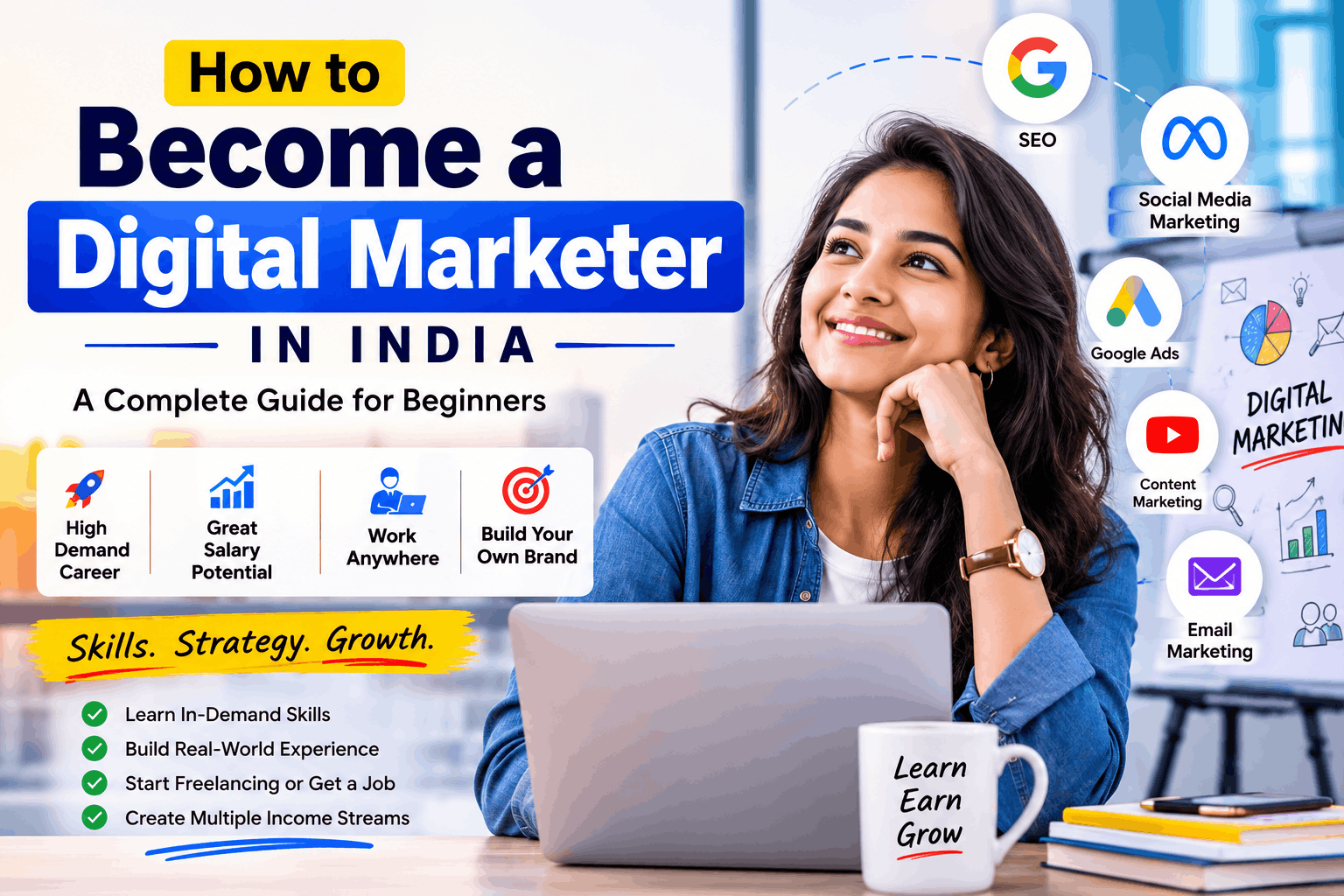
How to become a digital marketer in India is a question many students, working professionals, business owners, freelancers, and career changers are asking today. As businesses increasingly depend on websites, search engines, social media, online advertising, email, content, and artificial intelligence, digital marketing has become an important business skill as well as a career option.
The good news is that you do not necessarily need a traditional marketing degree to start. You can learn digital marketing skills through practical training, online resources, projects, internships, freelancing, and hands-on experimentation.
Whether you want to work for a company, start freelancing, promote your own business, or build a career in marketing, this guide explains how to become a digital marketer, what skills you need, which tools to learn, how much training may cost, and how you can start building practical experience.
What Is Digital Marketing?
Digital marketing is the process of promoting products, services, brands, or businesses through digital channels.
These channels can include:
- Search engines such as Google
- Websites and blogs
- Social media platforms
- Google Ads
- Meta Ads
- YouTube
- Email marketing
- WhatsApp marketing
- Content marketing
- Search engine optimization (SEO)
- Online marketplaces
- Mobile applications
For example, when a local business appears on Google when someone searches for a service, runs an Instagram advertisement, publishes helpful blog articles, or receives customers through YouTube, these activities can all be part of digital marketing.
A digital marketer’s job is not simply to post content. A good digital marketer understands the target audience, chooses appropriate channels, creates campaigns, measures results, and continuously improves performance.
How to Become a Digital Marketer in India
If you are wondering how to become a digital marketer in India, you can follow a structured learning path rather than trying to learn everything simultaneously.
A practical roadmap looks like this:
Understand marketing → Learn digital channels → Practice with real projects → Learn analytics → Build a portfolio → Get experience → Apply for jobs or start freelancing.
Let’s look at each step.
1. Understand the Basics of Marketing
Before learning complicated advertising platforms, understand the fundamentals of marketing.
You should know:
- Who your target customer is
- What problem your product solves
- How customers make purchasing decisions
- What makes an offer attractive
- What a marketing funnel is
- What leads and conversions mean
- How branding influences customers
- Why positioning matters
Digital tools change frequently, but marketing fundamentals remain important.
For example, knowing how to create a Facebook campaign is useful, but understanding who should see the advertisement and why they should respond is much more valuable.
2. Learn Search Engine Optimization (SEO)
SEO is one of the most important digital marketing skills.
Search engine optimization involves improving websites and content so that they can attract relevant organic traffic from search engines.
As a beginner, learn:
- Keyword research
- Search intent
- On-page SEO
- Technical SEO basics
- Internal linking
- Content optimization
- Meta titles and descriptions
- Image optimization
- Local SEO
- Link building
- Google Search Console
- SEO analytics
For example, instead of simply writing an article titled “Digital Marketing,” you might target a more specific search such as “how to become a digital marketer in India.”
This is where keyword research becomes important.
You should learn to identify what people are searching for and create genuinely useful content around those searches.
3. Learn Google Ads
Google Ads is another important skill for aspiring digital marketers.
Businesses use Google Ads to reach potential customers when they search for products or services.
A beginner should understand:
- Search campaigns
- Keyword targeting
- Match types
- Negative keywords
- Ad copy
- Landing pages
- Conversion tracking
- Bidding
- Quality Score
- Campaign optimization
- Performance measurement
Learning Google Ads can also create opportunities for freelance work because many small businesses need help generating leads through paid search.
4. Learn Meta Ads
Meta Ads, particularly Facebook and Instagram advertising, is widely used by businesses to generate awareness, leads, website traffic, and sales.
You should learn:
- Campaign objectives
- Audience targeting
- Custom audiences
- Lookalike audiences
- Creative testing
- Ad copy
- Lead generation campaigns
- Retargeting
- Conversion campaigns
- Campaign budgeting
- Cost-per-lead analysis
Do not focus only on learning how to click buttons inside the advertising platform.
Learn why a particular campaign structure is being used and how different audiences respond to different offers.
Social media marketing goes beyond publishing attractive posts.
A social media marketer should understand:
- Content strategy
- Content calendars
- Reels and short-form videos
- Community engagement
- Hashtag strategy
- Social media analytics
- Brand positioning
- Influencer marketing
- Paid social advertising
Different platforms have different audiences and content formats. A good strategy for Instagram may not work exactly the same way on LinkedIn or YouTube.
6. Learn Content Marketing
Content is at the centre of many digital marketing strategies.
Content can include:
- Blog posts
- Videos
- Reels
- Infographics
- Social media posts
- Case studies
- Email newsletters
- Guides
- E-books
- Landing pages
The goal isn’t to produce content simply for the sake of publishing.
Good content should answer questions, solve problems, build trust, educate an audience, or encourage a specific action.
This is especially important for businesses using digital marketing for small business, where educational content can help establish credibility without requiring a huge advertising budget.
7. Learn Analytics and Measurement
One of the biggest differences between traditional marketing and modern digital marketing is the amount of measurable data available.
A digital marketer should understand metrics such as:
- Impressions
- Reach
- Click-through rate (CTR)
- Cost per click (CPC)
- Cost per lead (CPL)
- Conversion rate
- Return on ad spend (ROAS)
- Customer acquisition cost
- Engagement rate
- Website traffic
You should also become familiar with tools such as Google Analytics and Google Search Console.
Analytics helps answer an important question:
Is the marketing actually working?
Without measurement, marketing becomes guesswork.
8. Learn AI Tools for Digital Marketing
Artificial intelligence is becoming an important part of modern marketing workflows.
Learning AI tools for digital marketing can help marketers research ideas, create drafts, analyze information, generate variations, summarize data, and improve productivity.
Examples of AI-assisted marketing activities include:
- Content ideation
- Blog research
- Ad copy variations
- Social media content ideas
- Keyword clustering
- Customer research
- Email drafts
- Competitor research
- Data analysis
- Image generation
- Video content assistance
However, AI should be treated as a productivity tool rather than a replacement for marketing knowledge.
A marketer who understands customers, strategy, data, and positioning can use AI much more effectively than someone who simply generates generic content.
9. Learn Digital Marketing Tools
You don’t need to master every marketing tool available.
Start with a practical toolkit.
Some categories worth learning include:
SEO: Google Search Console, Google Analytics and keyword research platforms.
Advertising: Google Ads and Meta Ads Manager.
Design: Canva and other visual design tools.
Analytics: Google Analytics, advertising dashboards and spreadsheet tools.
Content: WordPress or another website/CMS platform.
AI: AI writing, research, image and productivity tools.
Communication: Email marketing and WhatsApp marketing platforms.
The important thing is not the number of tools on your resume. It is your ability to use tools to achieve marketing objectives.
10. Practice With Real Projects
This is one of the most important steps when learning digital marketing.
Don’t spend six months watching tutorials without doing anything.
Create your own projects.
For example, you could:
- Build a simple website
- Start a blog
- Create an Instagram page
- Run a small Google Ads experiment
- Create a mock Meta Ads campaign
- Optimize a website for SEO
- Create a content calendar
- Analyze a business’s online presence
- Build a sample marketing strategy
You can document your results and use them to build a portfolio.
Even a personal project can demonstrate practical skills when you have no professional experience.
Digital Marketing Courses: Are They Necessary?
A common question is whether you need digital marketing courses to become a digital marketer.
The answer is: not necessarily, but structured training can significantly reduce the time it takes to learn.
There is an enormous amount of free information available online. However, beginners often struggle because the information is scattered.
One tutorial teaches SEO. Another teaches Meta Ads. Another teaches content marketing. You may know individual concepts but still not understand how everything fits together.
A structured digital marketing training institute or practical online program can provide:
- A structured curriculum
- Live instruction
- Practical assignments
- Projects
- Mentorship
- Doubt-solving
- Industry examples
- Certification
- A clear learning path
The quality of the training matters more than simply having a certificate.
Look for training that gives you opportunities to actually practice marketing.
Digital Marketing Courses Online vs Classroom Training
Today, students can choose between classroom and online learning.
Digital marketing courses online can be useful for students and professionals who need flexibility.
Advantages include:
- Learn from home
- Flexible schedules
- Recorded resources
- Access from different cities
- Lower travel costs
- Convenient revision
Classroom learning can provide direct interaction and a structured environment.
For someone looking for digital marketing training in Mumbai, for example, both classroom and online options can be considered depending on schedule, location, budget, and preferred learning style.
The important question should not simply be “online or offline?”
Instead, ask:
Will I get enough practical experience to actually perform digital marketing work?
Digital Marketing Courses Fees: How Much Does Training Cost?
Another common search is digital marketing courses fees.
The cost varies significantly depending on the institute, curriculum, duration, trainer, live classes, projects, certification, mentorship, and specialization.
Short introductory programs can cost much less than comprehensive professional programs.
Before paying for a course, compare:
- Course duration
- Number of live classes
- Practical assignments
- Trainers
- Modules covered
- Tools taught
- Projects
- Certification
- Mentorship
- Placement or career support
- Refund and payment policies
Don’t choose a course only because it is expensive or because it promises a high salary.
A useful course should help you develop job-ready digital marketing skills.
Career Options After Learning Digital Marketing
Digital marketing provides several possible career paths.
You can work as a:
- Digital Marketing Executive
- SEO Executive
- SEO Specialist
- Social Media Executive
- Social Media Manager
- Google Ads Specialist
- Meta Ads Specialist
- Performance Marketer
- Content Marketer
- Email Marketing Specialist
- Digital Marketing Analyst
- Affiliate Marketing Specialist
- Marketing Consultant
You can also combine multiple skills and become a generalist digital marketer.
Later, you may choose to specialize in a particular area such as SEO, paid advertising, social media, content marketing, analytics, or performance marketing.
Freelance Digital Marketing: Can You Work Independently?
Yes. Freelancing is another possible career path.
A freelance digital marketing salary does not work like a fixed employee salary because freelancers generally earn based on projects, retainers, hourly work, or performance arrangements.
A beginner may start with small assignments such as:
- Social media management
- SEO optimization
- Blog writing
- Website optimization
- Google Ads management
- Meta Ads management
- Lead generation
- Content creation
As your skills and client base grow, you can potentially move toward larger retainers and specialized services.
However, freelancing is not instant money.
You need three things:
Skill + portfolio + client acquisition.
Learning digital marketing is only half the journey. You also need to learn how to communicate with clients, prepare proposals, price services, report results, and retain customers.
How to Get Your First Digital Marketing Job
If your goal is employment, start building evidence of your skills.
Create a simple portfolio containing:
- An SEO project
- A sample Google Ads campaign
- A sample Meta Ads campaign
- A content calendar
- A social media strategy
- A website or blog project
- A basic analytics report
You don’t need ten years of experience to create a portfolio.
You can create sample projects using your own website, a hypothetical business, a friend’s business, or a small personal project.
When applying for jobs, focus on what you can actually demonstrate rather than filling your resume with dozens of certificates.
Digital Marketing for Small Business
Digital marketing is not only for large companies.
Small businesses can use digital channels to:
- Generate local leads
- Build brand awareness
- Get website visitors
- Promote offers
- Collect enquiries
- Build customer relationships
- Increase repeat business
For example, a local tutor, restaurant, salon, real estate consultant, coaching centre, gym, or service provider can use SEO, Google Business Profile, social media, Google Ads, Meta Ads, content marketing, and WhatsApp communication to reach potential customers.
This creates opportunities for digital marketers because small businesses often need affordable marketing support.
Digital Marketing Uses in Business
Some important digital marketing uses in business include:
Lead Generation
Businesses can use search engines, social media and advertising to attract potential customers.
Brand Awareness
Consistent content and advertising can help customers recognize a brand.
Customer Engagement
Social media, email and messaging platforms allow businesses to interact directly with customers.
Sales
E-commerce businesses can use digital campaigns to drive online purchases.
Retargeting
Businesses can reconnect with people who previously visited their website or interacted with their content.
Data-Driven Decision Making
Digital marketing provides measurable data that can help businesses understand customer behaviour.
How Long Does It Take to Become a Digital Marketer?
There is no fixed timeline.
A motivated beginner can learn the fundamentals relatively quickly, but becoming genuinely proficient requires continuous practice.
A practical learning progression might look like:
Month 1: Marketing fundamentals, SEO and content
Month 2: Social media, Google Ads and Meta Ads
Month 3: Analytics, AI tools and practical projects
After that: Portfolio building, internships, freelancing or job applications
The more projects you complete, the faster you develop confidence.
Remember that digital marketing is an evolving field. Even experienced marketers need to keep learning.
Skills That Can Make You a Better Digital Marketer
Technical knowledge is important, but soft skills matter too.
Develop:
- Communication
- Creativity
- Analytical thinking
- Copywriting
- Problem solving
- Research
- Presentation
- Time management
- Customer understanding
- Adaptability
A marketer who can understand a business problem and communicate a solution clearly can become more valuable than someone who only knows how to operate advertising software.
Common Mistakes Beginners Make
Trying to Learn Everything at Once
Digital marketing is huge. Start with the fundamentals and gradually expand.
Focusing Only on Certificates
Certificates can demonstrate learning, but practical ability matters more.
Avoiding Analytics
If you don’t understand numbers, you won’t know whether your campaign is successful.
Not Practicing
Watching videos isn’t the same as running campaigns or optimizing websites.
Copying Other People’s Content
Study successful marketing, but develop your own ideas and strategies.
Expecting Instant Freelance Income
Building a client base takes time.
Should You Become a Digital Marketer in 2026?
If you enjoy technology, marketing, communication, creativity, business, data, or online platforms, digital marketing can be a useful career path to explore.
It can provide opportunities across employment, freelancing, entrepreneurship, consulting, and business ownership.
The biggest advantage is that you can begin practising many digital marketing skills without needing a large investment.
You can start a blog, create social media content, build a website, analyze search results, learn advertising platforms, and experiment with AI tools.
The key is to move from learning to doing.
Start Your Digital Marketing Journey
If you are serious about learning how to become a digital marketer, don’t wait until you know everything.
Start with the fundamentals.
Learn SEO. Understand social media. Practice Google Ads and Meta Ads. Study analytics. Explore AI tools. Build projects. Create a portfolio. Then start looking for internships, jobs, freelance clients, or opportunities to market your own business.
For learners looking for structured digital marketing training in Mumbai or flexible digital marketing courses online, Shikshanest Digital Academy can be explored as a learning option.
Frequently Asked Questions
1. How to become a digital marketer without a degree?
You can start by learning digital marketing fundamentals, SEO, social media, advertising, analytics and content marketing. Build practical projects and a portfolio to demonstrate your skills.
2. Is digital marketing a good career in India?
Digital marketing can be a useful career option because businesses across industries use websites, search, social media, content and online advertising to reach customers.
3. Can I learn digital marketing online?
Yes. There are many digital marketing courses online, including beginner and advanced programs. Choose a course that emphasizes practical learning and projects.
4. Can I become a freelance digital marketer?
Yes. After developing practical skills, you can offer services such as SEO, social media management, content marketing, Google Ads, Meta Ads and lead generation to businesses.
5. How much do digital marketing courses cost?
Digital marketing course fees vary widely depending on duration, curriculum, trainer, practical work, mentorship and certification. Compare the actual learning value rather than choosing solely based on price.
6. What are the most important digital marketing skills?
SEO, paid advertising, social media marketing, content marketing, analytics, copywriting, communication and AI-assisted marketing are valuable skills to develop.
7. What AI tools should digital marketers learn?
Digital marketers can explore AI tools for research, content ideation, copywriting, analytics, image creation, campaign assistance and productivity. The right tools depend on the marketer’s specific workflow.
8. Can digital marketing be learned by beginners?
Absolutely. Beginners can start with marketing fundamentals and gradually learn individual digital channels through structured learning and practical projects.
Final Thoughts
The answer to how to become a digital marketer in India is not simply “complete a course.”
A successful digital marketer continuously learns, experiments, measures results, understands customers, and adapts to changes in technology.
Start small. Pick a few important skills. Build real projects. Document your work. Create a portfolio. Then use those skills to pursue employment, freelancing, entrepreneurship, or growth for your own business.
The digital marketing industry will continue to evolve, especially with AI, automation, changing search behaviour, social media trends, and new advertising technologies.
The people who combine marketing fundamentals + practical skills + data + creativity + AI will be better positioned to take advantage of those opportunities.
If you are ready to begin, your first step doesn’t have to be complicated:
Learn → Practice → Build → Measure → Improve → Earn.
That is the practical journey toward becoming a digital marketer.
2 thoughts on “How to Become a Digital Marketer in India: A Complete Beginner’s Guide”